廪 (lǐn) means "Granary / Government stipend" in Chinese. It has 16 strokes with the radical 广.
Rated 4.2/5 in difficulty (advanced).
Appears in 3+ common words including 仓廪 (cāng lǐn), 廪给 (lǐn gěi), 廪食 (lǐn shí).
Due to its 16 strokes, Hanzi Writer's error detection shows 廪 requires focused practice — most learners need 10+ attempts for consistent accuracy.
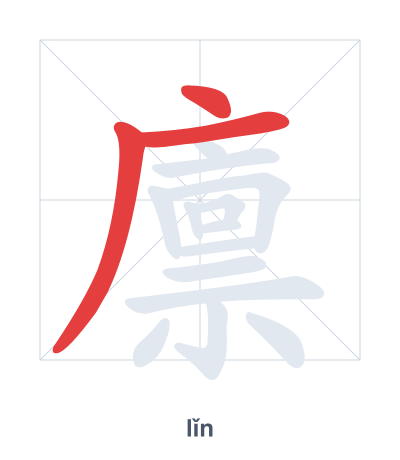
Open Hanzi Writer to see the animated stroke order and practice writing 廪 with real-time feedback.
The character 廪 (lǐn) is written with 16 strokes. Follow the standard Chinese stroke order: top to bottom, left to right, outside before inside. The radical 广 is one of its key components.
Practice the correct stroke order with the Hanzi Writer app to see animated stroke-by-stroke guidance with real-time feedback.
廪 means Granary / Government stipend.
The character 廪 combines the radical 广 (a roof/building) with 禀, which originally depicted a granary receiving grain (禾). Its ancient form showed a storage structure filled with grain, linking directly to its meaning of a granary or government stipend.
💡 Memory Tip: Picture a large government building (广) where two officials (like the components in 禀) stack grain sacks labeled 'Stipend' under a roof.
仓廪里有粮食。
cāng lǐn lǐ yǒu liáng shí
There is grain in the granary.
官府发给廪给。
guān fǔ fā gěi lǐn gěi
The government office issued food rations.
廪食非常充足。
lǐn shí fēi cháng chōng zú
The food supplies are very sufficient.
Open Hanzi Writer to see the animated stroke order and practice writing 廪 with real-time feedback.
✨ Animated stroke order · Handwriting recognition · HSK-graded practice · Free to use
The character 廪 has the radical 广 (yǎn), which means a building or shelter, on top. Beneath it is 稟 (bǐng), which originally meant to receive grain; together, the shelter for receiving grain conveys the idea of a granary or government stipend.