廑 (jǐn) means "hut, diligent, or barely" in Chinese. It has 14 strokes with the radical 广.
Rated 4.2/5 in difficulty (advanced).
Appears in 3+ common words including 廑念 (jǐn niàn), 廑怀 (jǐn huái), 廑劳 (jǐn láo).
Due to its 14 strokes, Hanzi Writer's error detection shows 廑 requires focused practice — most learners need 10+ attempts for consistent accuracy.
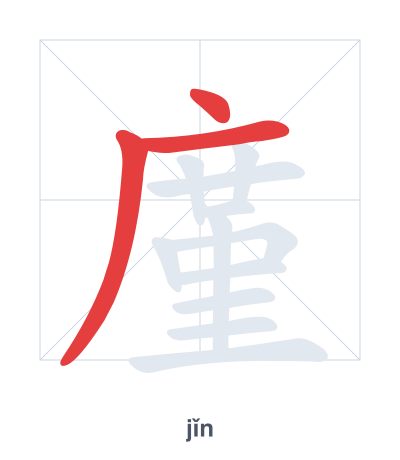
Open Hanzi Writer to see the animated stroke order and practice writing 廑 with real-time feedback.
The character 廑 (jǐn) is written with 14 strokes. Follow the standard Chinese stroke order: top to bottom, left to right, outside before inside. The radical 广 is one of its key components.
Practice the correct stroke order with the Hanzi Writer app to see animated stroke-by-stroke guidance with real-time feedback.
廑 means hut, diligent, or barely.
廑 combines the radical 广 (shelter) with 堇, which originally depicted a clay figurine or served as a phonetic component, together forming the image of a simple hut made of earth. Later it was borrowed to write the word for 'diligent' (cognate with 勤) and also extended to mean 'barely' in classical contexts.
💡 Memory Tip: Picture a cramped hut (广) where a person (堇, shaped like a bent figure) works so diligently that they barely have room to move.
他廑念远方的家。
tā jǐn niàn yuǎn fāng de jiā
He deeply misses his home far away.
心中深表廑怀。
xīn zhōng shēn biǎo jǐn huái
Expressing deep concern and solicitude.
感谢您的廑劳。
gǎn xiè nín de jǐn láo
Thank you for your hard work and toil.
Open Hanzi Writer to see the animated stroke order and practice writing 廑 with real-time feedback.
✨ Animated stroke order · Handwriting recognition · HSK-graded practice · Free to use
The character 廑 consists of the radical 广 (shelter or house) and the component 堇. The radical suggests a building like a hut, while 堇 contributes the ideas of diligence and hard work, which are also meanings of 廑. Together, they visually represent a hut where someone works diligently.