拎 (līn) means "To carry / To lift (with one hand)" in Chinese. It has 8 strokes with the radical 扌, and is HSK Level 7.
Rated 3.7/5 in difficulty (challenging).
Harder than 26% of HSK Level 7 characters.
Appears in 3+ common words including 拎包 (līn bāo), 拎着 (līn zhe), 拎东西 (līn dōng xī).
Due to its 8 strokes, Hanzi Writer's error detection shows 拎 requires focused practice — most learners need 10+ attempts for consistent accuracy.
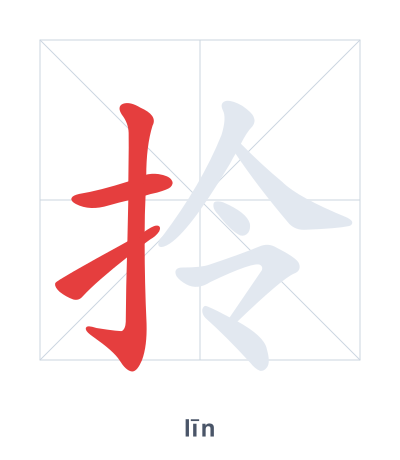
Open Hanzi Writer to see the animated stroke order and practice writing 拎 with real-time feedback.
The character 拎 (līn) is written with 8 strokes. Follow the standard Chinese stroke order: top to bottom, left to right, outside before inside. The radical 扌 is one of its key components.
Practice the correct stroke order with the Hanzi Writer app to see animated stroke-by-stroke guidance with real-time feedback.
拎 means To carry / To lift (with one hand).
As an HSK Level 7 character, 拎 is an intermediate-level character.
It combines the hand radical 扌 (hand) with 令 (lìng), a phonetic component that also evokes the idea of giving an order—so visually, the hand is commanded to lift something.
💡 Memory Tip: Picture your hand (扌) giving a sharp command (令) to hoist a heavy shopping bag straight up into the air.
他帮妈妈拎包。
tā bāng mā mā līn bāo
He helped his mother carry the bag.
他拎着一袋水果。
tā līn zhe yī dài shuǐ guǒ
He is carrying a bag of fruit.
拎东西很累。
līn dōng xī hěn lèi
Carrying things is tiring.
Open Hanzi Writer to see the animated stroke order and practice writing 拎 with real-time feedback.
✨ Animated stroke order · Handwriting recognition · HSK-graded practice · Free to use
The left side is the radical 扌, which means "hand" and indicates the action involves the hand. The right side is 令 (lìng), gives a hint to the pronunciation. Together, 拎 means to carry or lift something with one hand.