獠 (liáo) means "Fierce; long-fanged" in Chinese. It has 15 strokes with the radical 犭.
Rated 4.2/5 in difficulty (advanced).
Appears in 3+ common words including 獠牙 (liáo yá), 獠面 (liáo miàn), 獠牙长 (liáo yá zhǎng).
Due to its 15 strokes, Hanzi Writer's error detection shows 獠 requires focused practice — most learners need 10+ attempts for consistent accuracy.
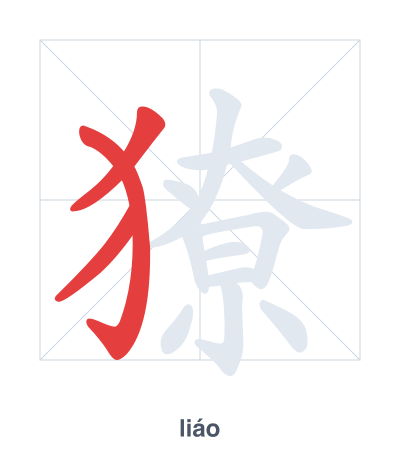
Open Hanzi Writer to see the animated stroke order and practice writing 獠 with real-time feedback.
The character 獠 (liáo) is written with 15 strokes. Follow the standard Chinese stroke order: top to bottom, left to right, outside before inside. The radical 犭 is one of its key components.
Practice the correct stroke order with the Hanzi Writer app to see animated stroke-by-stroke guidance with real-time feedback.
獠 means Fierce; long-fanged.
獠 is a phono-semantic compound: the radical 犭 (dog/beast) signals a fierce animal, while 尞 (liáo) adds the sound. The character originally depicted a beast with long, frightening fangs, emphasizing its savage nature.
💡 Memory Tip: Picture a savage wolf (犭) baring long fangs that look like the letters L-I-A-O as it snarls.
野猪有尖尖的獠牙。
yě zhū yǒu jiān jiān de liáo yá
Wild boars have sharp tusks.
他的样子青面獠牙。
tā de yàng zi qīng miàn liáo yá
He looks like a monster with a green face and long fangs.
这只怪兽獠牙很长。
zhè zhǐ guài shòu liáo yá hěn zhǎng
This monster has very long fangs.
Open Hanzi Writer to see the animated stroke order and practice writing 獠 with real-time feedback.
✨ Animated stroke order · Handwriting recognition · HSK-graded practice · Free to use
獠 is made of the radical 犭 (dog/beast) on the left, showing it relates to animals. The right part 尞 gives the sound liáo and suggests something long or burning, which combined with the beast radical creates the idea of a fierce animal with long fangs.