蠡 (lí/lǐ) means "Woodworm / Gourd ladle" in Chinese. It has 21 strokes with the radical 虫.
Rated 4.2/5 in difficulty (advanced).
Appears in 3+ common words including 蠡测 (lí cè), 范蠡 (fàn lǐ), 蠡县 (lǐ xiàn).
Due to its 21 strokes, Hanzi Writer's error detection shows 蠡 requires focused practice — most learners need 10+ attempts for consistent accuracy.
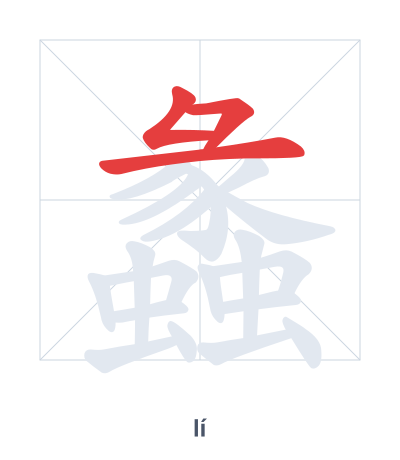
Open Hanzi Writer to see the animated stroke order and practice writing 蠡 with real-time feedback.
The character 蠡 (lí/lǐ) is written with 21 strokes. Follow the standard Chinese stroke order: top to bottom, left to right, outside before inside. The radical 虫 is one of its key components.
Practice the correct stroke order with the Hanzi Writer app to see animated stroke-by-stroke guidance with real-time feedback.
蠡 means Woodworm / Gourd ladle.
This is a polyphonic character with readings: lí, lǐ.
蠡 is a compound character: the top 彖 (originally a pig's head, here phonetic lí) provides sound, while the bottom 虫 (insect) indicates a woodworm, an insect that bores into wood. The meaning 'gourd ladle' is a homophone borrowing, likely from the visual resemblance of a hollowed gourd to the character's shape.
💡 Memory Tip: Picture a gourd (彖) hollowed out by woodworms (虫) into a ladle — that's 蠡, where the worm becomes the tool.
不要以管窥蠡。
bú yào yǐ guǎn kuī lí
Don't have a narrow and limited view of things.
范蠡是古代名人。
fàn lǐ shì gǔ dài míng rén
Fan Li is a famous figure from ancient times.
他住在蠡县。
tā zhù zài lǐ xiàn
He lives in Lixian County.
Open Hanzi Writer to see the animated stroke order and practice writing 蠡 with real-time feedback.
✨ Animated stroke order · Handwriting recognition · HSK-graded practice · Free to use
蠡 is composed of the top component 彖 and the bottom radical 虫 (insect/creature). The radical 虫 connects to the meaning of woodworm, a small creature that eats wood. The top part 彖 contributes the pronunciation and may relate to the shape of a gourd ladle.