嫠 (lí) means "Widow." in Chinese. It has 14 strokes with the radical 女.
Rated 4.2/5 in difficulty (advanced).
Appears in 3+ common words including 嫠妇 (lí fù), 嫠忧 (lí yōu), 孤嫠 (gū lí).
Due to its 14 strokes, Hanzi Writer's error detection shows 嫠 requires focused practice — most learners need 10+ attempts for consistent accuracy.
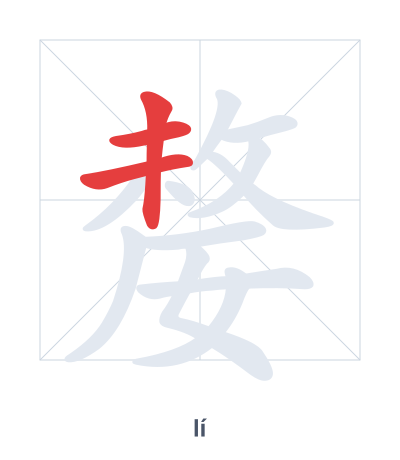
Open Hanzi Writer to see the animated stroke order and practice writing 嫠 with real-time feedback.
The character 嫠 (lí) is written with 14 strokes. Follow the standard Chinese stroke order: top to bottom, left to right, outside before inside. The radical 女 is one of its key components.
Practice the correct stroke order with the Hanzi Writer app to see animated stroke-by-stroke guidance with real-time feedback.
嫠 means Widow..
The character 嫠 combines the radical 女 (woman) with 厘 (lí), which originally meant 'to divide' or 'separate'. Together, they depict a woman who has been separated from her husband by death—a widow. The right component also provides the pronunciation.
💡 Memory Tip: A widow (女) lives alone under a cliff (厂) in a remote village (里)—that's 嫠.
那个嫠妇生活很辛苦。
nà ge lí fù shēng huó hěn xīn kǔ
That widow's life is very hard.
她心中充满了嫠忧。
tā xīn zhōng chōng mǎn le lí yōu
Her heart was filled with a widow's sorrow.
孤嫠的生活很冷清。
gū lí de shēng huó hěn lěng qīng
A widow's life is very lonely and desolate.
Open Hanzi Writer to see the animated stroke order and practice writing 嫠 with real-time feedback.
✨ Animated stroke order · Handwriting recognition · HSK-graded practice · Free to use
嫠 is made of the top part 未 (meaning "not yet" or "not") and the bottom part 女 (woman). This combination suggests a woman who is "not" with her husband, which leads to the meaning of widow.