磊 (lěi) means "pile of stones / open and upright" in Chinese. It has 15 strokes with the radical 石, and is HSK Level 7.
Rated 4.2/5 in difficulty (advanced).
Harder than 75% of HSK Level 7 characters.
Appears in 3+ common words including 磊落 (lěi luò), 光明磊落 (guāng míng lěi luò), 磊磊 (lěi lěi).
Due to its 15 strokes, Hanzi Writer's error detection shows 磊 requires focused practice — most learners need 10+ attempts for consistent accuracy.
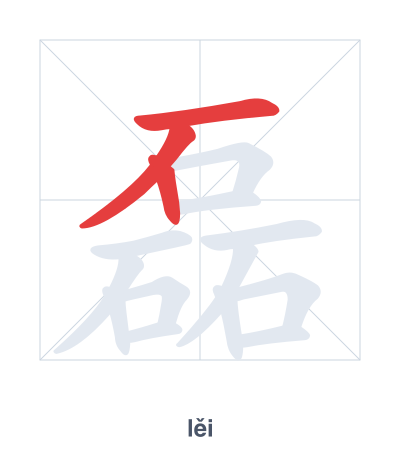
Open Hanzi Writer to see the animated stroke order and practice writing 磊 with real-time feedback.
The character 磊 (lěi) is written with 15 strokes. Follow the standard Chinese stroke order: top to bottom, left to right, outside before inside. The radical 石 is one of its key components.
Practice the correct stroke order with the Hanzi Writer app to see animated stroke-by-stroke guidance with real-time feedback.
磊 means pile of stones / open and upright.
As an HSK Level 7 character, 磊 is an intermediate-level character.
磊 is a compound character formed by three 石 (stone) radicals, literally depicting a pile of stones stacked together. The repetition of the stone radical emphasizes the meaning of many stones accumulated, which later extended to describe someone who is open and upright like a solid stone structure.
💡 Memory Tip: Picture three stones (石) neatly stacked on top of each other, forming a stable and upright pile that stands open and honest in the sun.
他的性格非常磊落。
tā de xìng gé fēi cháng lěi luò
He has a very upright and open personality.
他做事一向光明磊落。
tā zuò shì yí xiàng guāng míng lěi luò
He has always been open and aboveboard in his actions.
山上有很多磊磊的石块。
shān shàng yǒu hěn duō lěi lěi de shí kuài
There are many piles of rocks on the mountain.
Open Hanzi Writer to see the animated stroke order and practice writing 磊 with real-time feedback.
✨ Animated stroke order · Handwriting recognition · HSK-graded practice · Free to use
磊 is made of three copies of the radical 石 (stone) stacked together. This stacking directly creates the meaning "pile of stones." The idea of being open and upright comes from the stability and honesty suggested by a solid pile of stones.