鲲 (kūn) means "Kun (a legendary giant fish)" in Chinese. It has 16 strokes with the radical 鱼.
Rated 4.2/5 in difficulty (advanced).
Appears in 3+ common words including 鲲鹏 (kūn péng), 巨鲲 (jù kūn), 鲲鱼 (kūn yú).
Due to its 16 strokes, Hanzi Writer's error detection shows 鲲 requires focused practice — most learners need 10+ attempts for consistent accuracy.
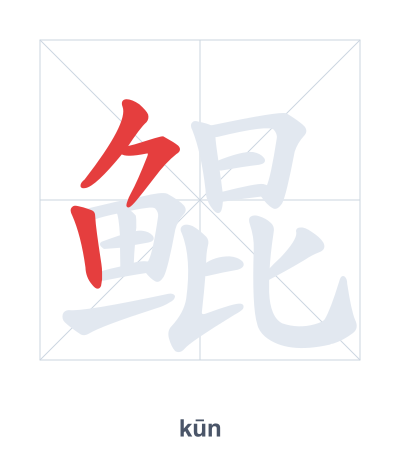
Open Hanzi Writer to see the animated stroke order and practice writing 鲲 with real-time feedback.
The character 鲲 (kūn) is written with 16 strokes. Follow the standard Chinese stroke order: top to bottom, left to right, outside before inside. The radical 鱼 is one of its key components.
Practice the correct stroke order with the Hanzi Writer app to see animated stroke-by-stroke guidance with real-time feedback.
鲲 means Kun (a legendary giant fish).
鲲 is a compound character with the radical 鱼 (fish) on the left, indicating its semantic category, and 昆 (kūn) on the right as a phonetic component. The character refers to a legendary giant fish from Zhuangzi's philosophy, symbolizing immense transformation and size.
💡 Memory Tip: Picture a giant fish (鱼) under the sun (日) being compared (比) to everything else—that's the legendary Kun, the biggest fish of all.
鲲鹏是中国神话里的大鸟。
kūn péng shì zhōng guó shén huà lǐ de dà niǎo
Kunpeng is a giant bird in Chinese mythology.
传说中巨鲲的身体很大。
chuán shuō zhōng jù kūn de shēn tǐ hěn dà
Legend says the giant Kun fish has an enormous body.
鲲鱼在水里游得很快。
kūn yú zài shuǐ lǐ yóu dé hěn kuài
The Kun fish swims very fast in the water.
Open Hanzi Writer to see the animated stroke order and practice writing 鲲 with real-time feedback.
✨ Animated stroke order · Handwriting recognition · HSK-graded practice · Free to use
鲲 is made of two parts: the left radical 鱼 (fish) and the right component 昆 (kūn). The fish radical shows it is a type of fish, while 昆 gives the pronunciation and hints at the idea of something large or ancient. Together they create the meaning of a legendary giant fish.