睇 (dì) means "To look at; to glance." in Chinese. It has 12 strokes with the radical 目.
Rated 4.2/5 in difficulty (advanced).
Appears in 3+ common words including 睇视 (dì shì), 睇一眼 (dì yī yǎn), 睇眄 (dì miǎn).
Due to its 12 strokes, Hanzi Writer's error detection shows 睇 requires focused practice — most learners need 10+ attempts for consistent accuracy.
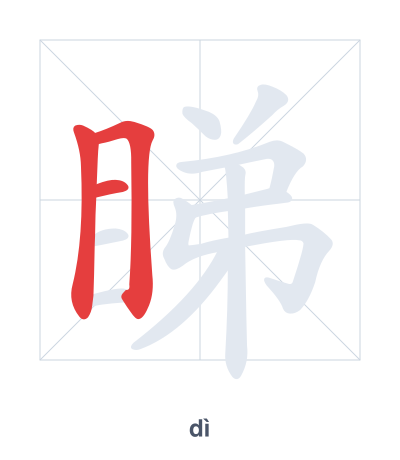
Open Hanzi Writer to see the animated stroke order and practice writing 睇 with real-time feedback.
The character 睇 (dì) is written with 12 strokes. Follow the standard Chinese stroke order: top to bottom, left to right, outside before inside. The radical 目 is one of its key components.
Practice the correct stroke order with the Hanzi Writer app to see animated stroke-by-stroke guidance with real-time feedback.
睇 means To look at; to glance..
睇 is a compound character with the radical 目 (eye) indicating its meaning relates to sight. The right component 弟 (dì) provides the pronunciation, originally meaning 'younger brother' but here acting as a phonetic. Together, they convey the action of looking or glancing.
💡 Memory Tip: Imagine your younger brother (弟) catching your eye (目) with a quick glance across the room.
他斜着眼睇视前方。
tā xié zhuó yǎn dì shì qián fāng
He squinted and looked ahead.
她回头睇了他一眼。
tā huí tóu dì le tā yī yǎn
She turned back and glanced at him.
两人互相睇眄微笑。
liǎng rén hù xiāng dì miǎn wēi xiào
The two looked at each other and smiled.
Open Hanzi Writer to see the animated stroke order and practice writing 睇 with real-time feedback.
✨ Animated stroke order · Handwriting recognition · HSK-graded practice · Free to use
睇 consists of the radical 目 (eye) on the left, which gives the meaning of seeing, and the component 弟 (dì) on the right, which provides the pronunciation. The eye radical directly connects to the character's meaning "to look" or "to glance."