揩 (kāi) means "to wipe" in Chinese. It has 12 strokes with the radical 扌.
Rated 4.2/5 in difficulty (advanced).
Appears in 3+ common words including 揩汗 (kāi hàn), 揩干净 (kāi gān jìng), 揩油 (kāi yóu).
Due to its 12 strokes, Hanzi Writer's error detection shows 揩 requires focused practice — most learners need 10+ attempts for consistent accuracy.
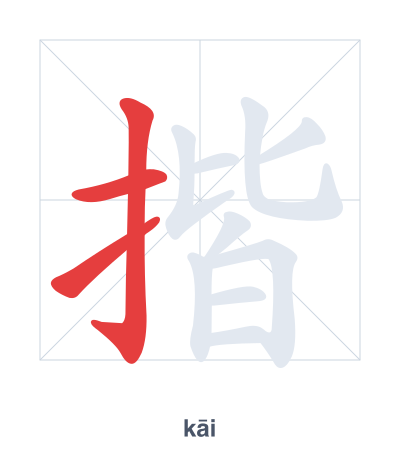
Open Hanzi Writer to see the animated stroke order and practice writing 揩 with real-time feedback.
The character 揩 (kāi) is written with 12 strokes. Follow the standard Chinese stroke order: top to bottom, left to right, outside before inside. The radical 扌 is one of its key components.
Practice the correct stroke order with the Hanzi Writer app to see animated stroke-by-stroke guidance with real-time feedback.
揩 means to wipe.
揩 is a phono-semantic compound: the radical 扌 (hand) indicates an action done by hand, and 皆 (jiē, 'all') provides the approximate pronunciation kāi. The character visually suggests a hand (扌) performing a wiping motion over every surface (皆).
💡 Memory Tip: Imagine your hand (扌) wiping every (皆) drop of sweat off your brow.
他用毛巾揩汗。
tā yòng máo jīn kāi hàn
He wiped the sweat with a towel.
把桌子揩干净。
bǎ zhuō zi kāi gān jìng
Wipe the table clean.
别想揩公司的油。
bié xiǎng kāi gōng sī de yóu
Don't try to take advantage of the company's resources.
Open Hanzi Writer to see the animated stroke order and practice writing 揩 with real-time feedback.
✨ Animated stroke order · Handwriting recognition · HSK-graded practice · Free to use
揩 is composed of the radical 扌 (hand) on the left and the phonetic component 皆 (jiē) on the right. The hand radical indicates that the character involves a hand action, which is wiping. The phonetic component hints at the pronunciation kāi, though not exact.