哒 (dá) means "Da (sound of clicking)" in Chinese. It has 9 strokes with the radical 口.
Rated 4/5 in difficulty (challenging).
Appears in 3+ common words including 萌萌哒 (méng méng dá), 哒哒 (dá dá), 滴哒 (dī dá).
Due to its 9 strokes, Hanzi Writer's error detection shows 哒 requires focused practice — most learners need 10+ attempts for consistent accuracy.
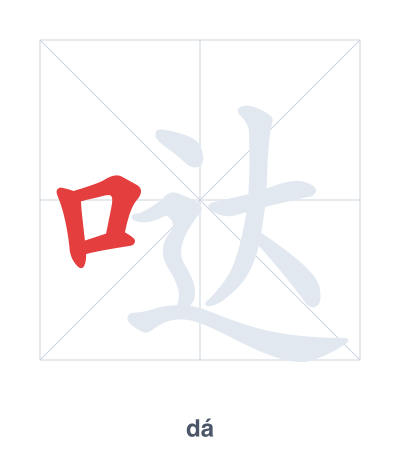
Open Hanzi Writer to see the animated stroke order and practice writing 哒 with real-time feedback.
The character 哒 (dá) is written with 9 strokes. Follow the standard Chinese stroke order: top to bottom, left to right, outside before inside. The radical 口 is one of its key components.
Practice the correct stroke order with the Hanzi Writer app to see animated stroke-by-stroke guidance with real-time feedback.
哒 means Da (sound of clicking).
哒 is a compound character combining the mouth radical 口 (indicating sound or speech) with 达 (dá, meaning 'to reach'), which provides the pronunciation. This structure creates a phonetic loan character used to mimic the clicking sound 'da' in modern Chinese, such as in 嘀哒 (dī dā) for 'tick-tock'.
💡 Memory Tip: Imagine a mouth (口) making a clicking 'da' sound as a big (大) horse trots away (辶) with each hoofbeat going 'dá, dá, dá'.
妹妹长得萌萌哒。
mèi mèi zhǎng dé méng méng dá
My younger sister looks adorable.
马蹄声哒哒响。
mǎ tí shēng dá dá xiǎng
The horse hooves are clopping.
钟表滴哒滴哒走。
zhōng biǎo dī dá dī dá zǒu
The clock is ticking.
Open Hanzi Writer to see the animated stroke order and practice writing 哒 with real-time feedback.
✨ Animated stroke order · Handwriting recognition · HSK-graded practice · Free to use
哒 is a phono-semantic compound: the left radical 口 (mouth) indicates sound-related meanings, and the right part 达 provides the pronunciation dá. Together they represent an onomatopoeic word for clicking or clattering sounds.