爵 (jué) means "Title of nobility / Ancient wine vessel" in Chinese. It has 17 strokes with the radical 爫, and is HSK Level 7.
Rated 3.8/5 in difficulty (challenging).
Harder than 33% of HSK Level 7 characters.
Appears in 3+ common words including 爵士 (jué shì), 爵位 (jué wèi), 公爵 (gōng jué).
Due to its 17 strokes, Hanzi Writer's error detection shows 爵 requires focused practice — most learners need 10+ attempts for consistent accuracy.
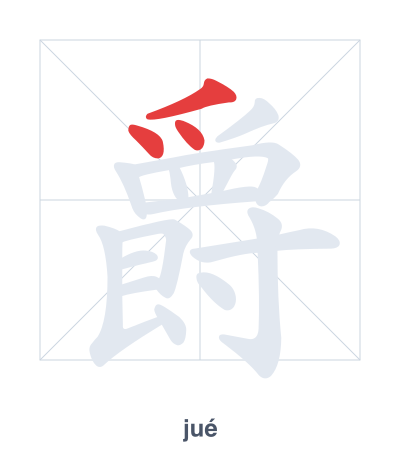
Open Hanzi Writer to see the animated stroke order and practice writing 爵 with real-time feedback.
The character 爵 (jué) is written with 17 strokes. Follow the standard Chinese stroke order: top to bottom, left to right, outside before inside. The radical 爫 is one of its key components.
Practice the correct stroke order with the Hanzi Writer app to see animated stroke-by-stroke guidance with real-time feedback.
爵 means Title of nobility / Ancient wine vessel.
As an HSK Level 7 character, 爵 is an intermediate-level character.
This character originally depicted an ancient bronze wine vessel with three legs, a spout, and a handle used in rituals. The top component (爫) represents a hand or lid, the central part shows the vessel's body, and the bottom (寸) is another hand holding it. Later, it came to mean 'title of nobility' because such vessels were used in ceremonies to confer ranks.
💡 Memory Tip: A claw (爫) snatches a fancy goblet while a hand (寸) steadies it—only a noble can drink from this 爵.
我喜欢爵士乐。
wǒ xǐ huān jué shì yuè
I like jazz music.
他获得了爵位。
tā huò dé le jué wèi
He was granted a title of nobility.
他是一位公爵。
tā shì yī wèi gōng jué
He is a duke.
Open Hanzi Writer to see the animated stroke order and practice writing 爵 with real-time feedback.
✨ Animated stroke order · Handwriting recognition · HSK-graded practice · Free to use
The character 爵 is composed of 爫 (claw) on top, then 罒 (net), then 又 (hand), and finally 寸 (thumb). This combination resembles an ancient wine vessel with a lid and a handle, reflecting its original meaning as a ritual wine vessel. Over time, the character came to represent a title of nobility, as such vessels were used in ceremonies to confer rank.