胫 (jìng) means "shin; shank" in Chinese. It has 9 strokes with the radical 月.
Rated 4/5 in difficulty (challenging).
Appears in 3+ common words including 胫骨 (jìng gǔ), 胫甲 (jìng jiǎ), 不胫而走 (bù jìng ér zǒu).
Due to its 9 strokes, Hanzi Writer's error detection shows 胫 requires focused practice — most learners need 10+ attempts for consistent accuracy.
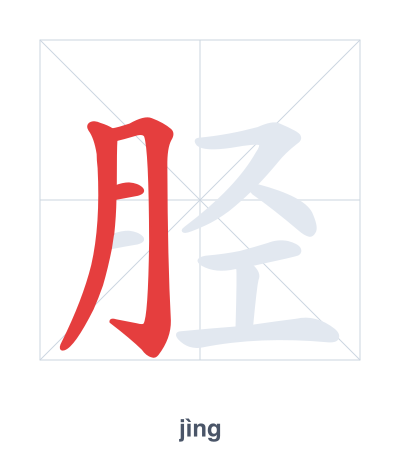
Open Hanzi Writer to see the animated stroke order and practice writing 胫 with real-time feedback.
The character 胫 (jìng) is written with 9 strokes. Follow the standard Chinese stroke order: top to bottom, left to right, outside before inside. The radical 月 is one of its key components.
Practice the correct stroke order with the Hanzi Writer app to see animated stroke-by-stroke guidance with real-time feedback.
胫 means shin; shank.
胫 is a compound character combining the radical 月 (flesh/body part) with 巠 (jīng, meaning a straight path or warp thread). The 月 indicates it's a body part, while 巠 provides phonetic and semantic hints of straightness, together referring to the straight bone of the lower leg—the shin.
💡 Memory Tip: Picture a moon-shaped dagger (月) piercing straight through a tight rope (巠) to mark the shinbone's straight path.
他的胫骨受伤了。
tā de jìng gǔ shòu shāng le
His tibia is injured.
战士穿着胫甲。
zhàn shì chuān zhe jìng jiǎ
The soldier is wearing greaves (shin armor).
这个消息不胫而走。
zhè ge xiāo xī bù jìng ér zǒu
The news spread like wildfire.
Open Hanzi Writer to see the animated stroke order and practice writing 胫 with real-time feedback.
✨ Animated stroke order · Handwriting recognition · HSK-graded practice · Free to use
The character 胫 is made of two parts: the left radical 月 (flesh) and the right part 巠 (jīng). The radical 月 indicates that the character relates to a body part, and the right side gives the pronunciation jìng. Together, they form the word for shin or shank.