浸 (jìn) means "To soak" in Chinese. It has 10 strokes with the radical 氵, and is HSK Level 7.
Rated 4.2/5 in difficulty (advanced).
Harder than 66% of HSK Level 7 characters.
Appears in 3+ common words including 浸泡 (jìn pào), 浸透 (jìn tòu), 沉浸 (chén jìn).
Due to its 10 strokes, Hanzi Writer's error detection shows 浸 requires focused practice — most learners need 10+ attempts for consistent accuracy.
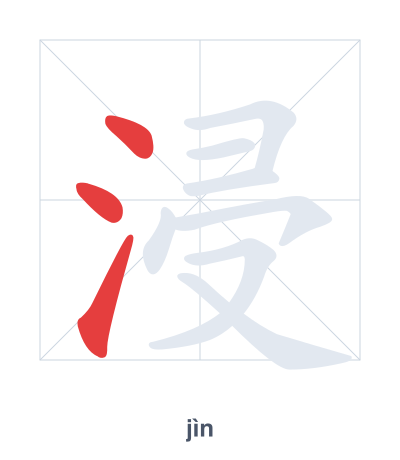
Open Hanzi Writer to see the animated stroke order and practice writing 浸 with real-time feedback.
The character 浸 (jìn) is written with 10 strokes. Follow the standard Chinese stroke order: top to bottom, left to right, outside before inside. The radical 氵 is one of its key components.
Practice the correct stroke order with the Hanzi Writer app to see animated stroke-by-stroke guidance with real-time feedback.
浸 means To soak.
As an HSK Level 7 character, 浸 is an intermediate-level character.
浸 is a phono-semantic compound. The left side (氵) is the water radical, indicating the meaning relates to water. The right side (㐭) originally appears in characters like 侵 (to invade) and contributes the sound jìn, with the combined sense of water gradually penetrating or 'invading' something, hence 'to soak.'
💡 Memory Tip: Picture water (氵) flooding into a covered container shaped like the right side 㐭, completely soaking everything inside.
把豆子浸泡一晚。
bǎ dòu zi jìn pào yī wǎn
Soak the beans overnight.
汗水浸透了衣服。
hàn shuǐ jìn tòu le yī fú
Sweat drenched the clothes.
沉浸在音乐中。
chén jìn zài yīn yuè zhōng
Immersed in music.
Open Hanzi Writer to see the animated stroke order and practice writing 浸 with real-time feedback.
✨ Animated stroke order · Handwriting recognition · HSK-graded practice · Free to use
The left side is the radical 氵 (water), which hints that the meaning involves water. The right side is 㴆 (a phonetic component), but in modern understanding, 浸 combines water with the idea of something being placed into or covered by water, hence 'to soak'.