睫 (jié) means "Eyelash." in Chinese. It has 13 strokes with the radical 目.
Rated 4.2/5 in difficulty (advanced).
Appears in 3+ common words including 睫毛 (jié máo), 迫在眉睫 (pò zài méi jié), 目不交睫 (mù bù jiāo jié).
Due to its 13 strokes, Hanzi Writer's error detection shows 睫 requires focused practice — most learners need 10+ attempts for consistent accuracy.
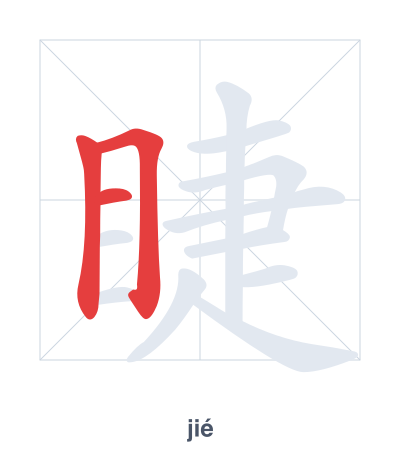
Open Hanzi Writer to see the animated stroke order and practice writing 睫 with real-time feedback.
The character 睫 (jié) is written with 13 strokes. Follow the standard Chinese stroke order: top to bottom, left to right, outside before inside. The radical 目 is one of its key components.
Practice the correct stroke order with the Hanzi Writer app to see animated stroke-by-stroke guidance with real-time feedback.
睫 means Eyelash..
睫 is a phono-semantic compound: the radical 目 (eye) indicates the meaning relates to the eye, while the component 疌 (jié) provides the sound and originally depicted a hand (又) stepping quickly (止), hinting at the rapid blinking motion of eyelashes.
💡 Memory Tip: Imagine an eye (目) with long eyelashes that are actually tiny hands (疌) waving quickly to brush away dust.
她的睫毛很长。
tā de jié máo hěn zhǎng
Her eyelashes are very long.
事情迫在眉睫。
shì qíng pò zài méi jié
The matter is imminent.
他忙得目不交睫。
tā máng dé mù bù jiāo jié
He is so busy that he hasn't slept a wink.
Open Hanzi Writer to see the animated stroke order and practice writing 睫 with real-time feedback.
✨ Animated stroke order · Handwriting recognition · HSK-graded practice · Free to use
The character 睫 is composed of the radical 目 (eye) on the left and the phonetic component 疌 on the right. The radical 目 directly connects the character to the eye, while 疌 provides a pronunciation clue (jié). Together, they form a character that specifically refers to the tiny hairs on the eyelid—eyelashes.