轿 (jiào) means "Sedan chair" in Chinese. It has 10 strokes with the radical 车, and is HSK Level 7.
Rated 4.2/5 in difficulty (advanced).
Harder than 92% of HSK Level 7 characters.
Appears in 3+ common words including 轿车 (jiào chē), 轿子 (jiào zi), 花轿 (huā jiào).
Due to its 10 strokes, Hanzi Writer's error detection shows 轿 requires focused practice — most learners need 10+ attempts for consistent accuracy.
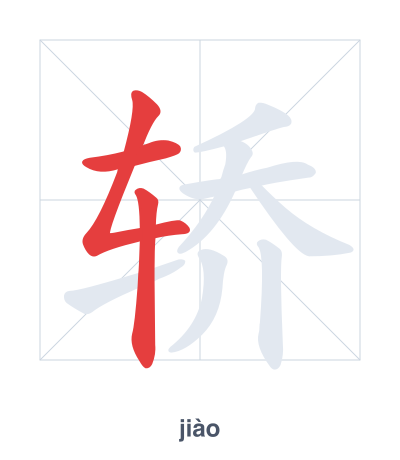
Open Hanzi Writer to see the animated stroke order and practice writing 轿 with real-time feedback.
The character 轿 (jiào) is written with 10 strokes. Follow the standard Chinese stroke order: top to bottom, left to right, outside before inside. The radical 车 is one of its key components.
Practice the correct stroke order with the Hanzi Writer app to see animated stroke-by-stroke guidance with real-time feedback.
轿 means Sedan chair.
As an HSK Level 7 character, 轿 is an intermediate-level character.
轿 combines the radical 车 (vehicle) with 乔 (tall, lofty), suggesting a tall vehicle carried by people. The sedan chair was a mode of transport for the elite, raised high above the ground.
💡 Memory Tip: Picture a tall (乔) vehicle (车) where two poles stick out like arms, carried by servants as a sedan chair.
爸爸买了一辆新轿车。
bà bà mǎi le yī liàng xīn jiào chē
Dad bought a new car.
古代人坐轿子出门。
gǔ dài rén zuò jiào zi chū mén
Ancient people went out in sedan chairs.
新娘坐上了花轿。
xīn niáng zuò shàng le huā jiào
The bride got into the bridal sedan chair.
Open Hanzi Writer to see the animated stroke order and practice writing 轿 with real-time feedback.
✨ Animated stroke order · Handwriting recognition · HSK-graded practice · Free to use
轿 is made of the radical 车 (vehicle) on the left and 乔 (tall) on the right. The left part relates to transportation, while the right part originally meant tall or lofty, so together they suggest a tall vehicle carried by people — a sedan chair.