跏 (jiā) means "to sit cross-legged" in Chinese. It has 12 strokes with the radical 足.
Rated 4.2/5 in difficulty (advanced).
Appears in 3+ common words including 跏趺 (jiā fū), 跏坐 (jiā zuò), 跏趺坐 (jiā fū zuò).
Due to its 12 strokes, Hanzi Writer's error detection shows 跏 requires focused practice — most learners need 10+ attempts for consistent accuracy.
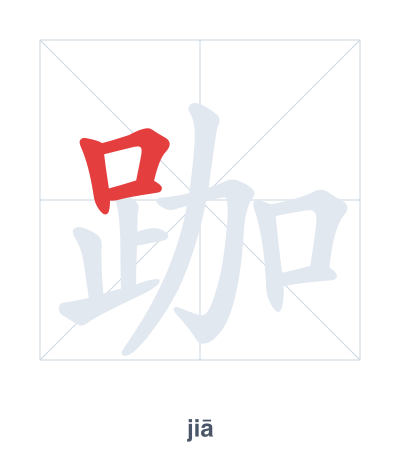
Open Hanzi Writer to see the animated stroke order and practice writing 跏 with real-time feedback.
The character 跏 (jiā) is written with 12 strokes. Follow the standard Chinese stroke order: top to bottom, left to right, outside before inside. The radical 足 is one of its key components.
Practice the correct stroke order with the Hanzi Writer app to see animated stroke-by-stroke guidance with real-time feedback.
跏 means to sit cross-legged.
跏 is a compound character that combines the radical 足 (foot) with the phonetic component 加 (jiā, meaning 'add'). The foot radical points to the posture involving the feet, while 加 suggests the action of adding one foot over the other to sit cross-legged.
💡 Memory Tip: Imagine adding (加) your feet (足) together, one on top of the other, to settle into a cross-legged sitting pose.
他正在跏趺而坐。
tā zhèng zài jiā fū ér zuò
He is sitting cross-legged.
这种跏坐很舒服。
zhè zhǒng jiā zuò hěn shū fú
This cross-legged sitting position is very comfortable.
老师教我们跏趺坐。
lǎo shī jiào wǒ men jiā fū zuò
The teacher taught us how to sit in the lotus position.
Open Hanzi Writer to see the animated stroke order and practice writing 跏 with real-time feedback.
✨ Animated stroke order · Handwriting recognition · HSK-graded practice · Free to use
跏 is composed of the radical 足 (foot) on the left and the phonetic component 加 (jiā, meaning 'add') on the right. The foot radical indicates that the character relates to feet or leg positions, while 加 suggests 'adding' or 'placing' the feet together crosswise. Together they convey the idea of placing the feet in a crossed position, i.e., sitting cross-legged.