髻 (jì) means "hair bun; topknot" in Chinese. It has 16 strokes with the radical 髟.
Rated 4.2/5 in difficulty (advanced).
Appears in 3+ common words including 发髻 (fà jì), 盘髻 (pán jì), 梳髻 (shū jì).
Due to its 16 strokes, Hanzi Writer's error detection shows 髻 requires focused practice — most learners need 10+ attempts for consistent accuracy.
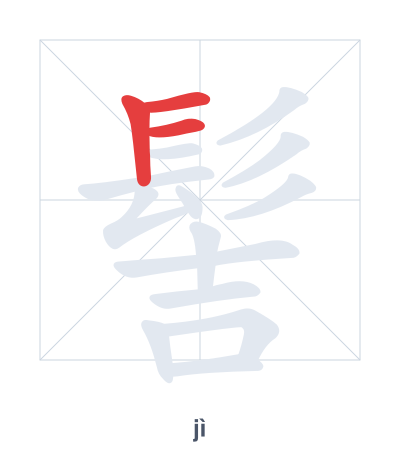
Open Hanzi Writer to see the animated stroke order and practice writing 髻 with real-time feedback.
The character 髻 (jì) is written with 16 strokes. Follow the standard Chinese stroke order: top to bottom, left to right, outside before inside. The radical 髟 is one of its key components.
Practice the correct stroke order with the Hanzi Writer app to see animated stroke-by-stroke guidance with real-time feedback.
髻 means hair bun; topknot.
| Character | 髻 |
| Pinyin | jì (ji) |
| Meaning | hair bun; topknot |
| Strokes | 16 |
| Radical | 髟 |
| Difficulty | 4.2/5 |
髻 combines the radical 髟 (long hair) with 吉 (jí, 'auspicious') as a phonetic component. The radical shows it relates to hair, while the overall character depicts a coiled or tied-up bun, often considered a neat and auspicious hairstyle in ancient China.
💡 Memory Tip: Picture a woman with long hair (髟) tying it into a perfect topknot that looks like the auspicious character 吉 sitting on her head.
她梳了一个发髻。
tā shū le yí gè fà jì
She wore her hair in a bun.
奶奶喜欢在脑后盘髻。
nǎi nǎi xǐ huān zài nǎo hòu pán jì
Grandma likes to wear her hair in a bun at the back of her head.
这种梳髻方式很古老。
zhè zhǒng shū jì fāng shì hěn gǔ lǎo
This way of styling a hair bun is very ancient.
Open Hanzi Writer to see the animated stroke order and practice writing 髻 with real-time feedback.
✨ Animated stroke order · Handwriting recognition · HSK-graded practice · Free to use
髻 is composed of 髟 (biāo) on top, meaning "long hair," and 吉 (jí) below, which originally contributed sound but now helps form the character. Together, 髟 shows this character relates to hair, and 髻 specifically means a hair bun or topknot.