髭 (zī) means "mustache" in Chinese. It has 16 strokes with the radical 髟.
Rated 4.2/5 in difficulty (advanced).
Appears in 3+ common words including 髭须 (zī xū), 髭胡 (zī hú), 剪髭 (jiǎn zī).
Due to its 16 strokes, Hanzi Writer's error detection shows 髭 requires focused practice — most learners need 10+ attempts for consistent accuracy.
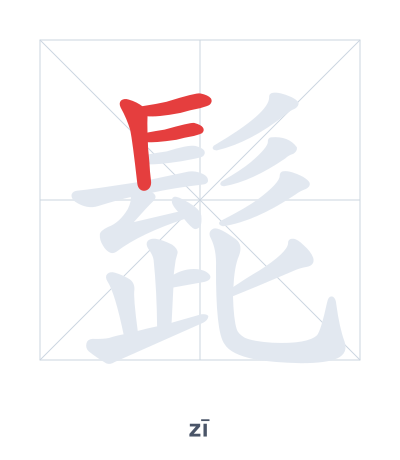
Open Hanzi Writer to see the animated stroke order and practice writing 髭 with real-time feedback.
The character 髭 (zī) is written with 16 strokes. Follow the standard Chinese stroke order: top to bottom, left to right, outside before inside. The radical 髟 is one of its key components.
Practice the correct stroke order with the Hanzi Writer app to see animated stroke-by-stroke guidance with real-time feedback.
髭 means mustache.
| Character | 髭 |
| Pinyin | zī (zi) |
| Meaning | mustache |
| Strokes | 16 |
| Radical | 髟 |
| Difficulty | 4.2/5 |
髭 combines the radical 髟 (long hair or beard) with 此 (cǐ, 'this'), which also provides the sound. The 髟 component indicates it relates to facial hair, while 此 suggests 'this spot' — the mustache area just below the nose.
💡 Memory Tip: Imagine a man pointing to the exact spot (此) under his nose and saying, 'This is where my hairy (髟) mustache grows!'
他的髭须很整齐。
tā de zī xū hěn zhěng qí
His mustache and beard are very neat.
他留着一点髭胡。
tā liú zhe yì diǎn zī hú
He has a bit of a mustache.
他正在镜子前剪髭。
tā zhèng zài jìng zi qián jiǎn zī
He is trimming his mustache in front of the mirror.
Open Hanzi Writer to see the animated stroke order and practice writing 髭 with real-time feedback.
✨ Animated stroke order · Handwriting recognition · HSK-graded practice · Free to use
The character 髭 combines the radical 髟 (hair) on top with 此 (cǐ, meaning 'this') below. Together they suggest 'the hair on this specific part of the face' — the mustache above the upper lip.