Hanzi Writer

How to Write 鬄 (dí) — Meaning “to shave (hair)”

18 strokes Radical: 髟

鬄 (dí) means "to shave (hair)" in Chinese. It has 18 strokes with the radical 髟.

Rated 4.2/5 in difficulty (advanced).

Appears in 3+ common words including 鬄发 (dí fā), 鬄除 (dí chú), 鬄头 (dí tóu).

Due to its 18 strokes, Hanzi Writer's error detection shows 鬄 requires focused practice — most learners need 10+ attempts for consistent accuracy.
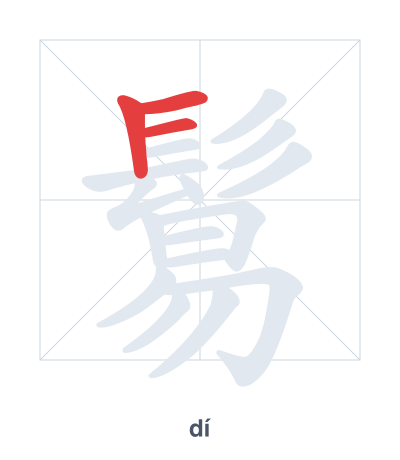
Stroke order practice for 鬄 - dí

Practice Writing 鬄 (dí)

Open Hanzi Writer to see the animated stroke order and practice writing 鬄 with real-time feedback.

The character (dí) is written with 18 strokes. Follow the standard Chinese stroke order: top to bottom, left to right, outside before inside. The radical is one of its key components.

Practice the correct stroke order with the Hanzi Writer app to see animated stroke-by-stroke guidance with real-time feedback.

means to shave (hair).

Character
Pinyindí (di)
Meaningto shave (hair)
Strokes18
Radical
Difficulty4.2/5

鬄 combines the radical 髟 (long hair) with 易 (yì) as a phonetic component, suggesting 'changing' or 'removing' hair. The act of shaving involves cutting off hair, directly linking the hair radical to the meaning.

💡 Memory Tip: Picture a barber using an 'easy' (易) electric razor to shave off a long lock of hair (髟).

dí fā
to shave hair; to get a haircut
dí chú
to shave off; to remove
dí tóu
to shave the head

他去店里鬄发。

tā qù diàn lǐ dí fā

He went to the shop for a haircut.

杂草被鬄除了。

zá cǎo bèi dí chú le

The weeds have been cleared away.

鬄头以后很凉快。

dí tóu yǐ hòu hěn liáng kuài

It feels very cool after shaving the head.

Character Pinyin Strokes Radical
(current) 18
16
xiū 16
16
Stroke order practice for 鬄 - dí

Practice Writing 鬄 (dí)

Open Hanzi Writer to see the animated stroke order and practice writing 鬄 with real-time feedback.

✨ Animated stroke order · Handwriting recognition · HSK-graded practice · Free to use

Frequently Asked Questions about 鬄

鬄 is composed of the radical 髟 on top, which means "hair" or "long hair," and the component 易 below, which contributes sound and a hint of "to change." Together, 髟 + 易 suggests changing or removing hair, which directly connects to the action of shaving.

Characters with Radical 髟

Other 18-Stroke Characters