髡 (kūn) means "to shave the head" in Chinese. It has 13 strokes with the radical 髟.
Rated 4.2/5 in difficulty (advanced).
Appears in 3+ common words including 髡发 (kūn fā), 髡刑 (kūn xíng), 髡首 (kūn shǒu).
Due to its 13 strokes, Hanzi Writer's error detection shows 髡 requires focused practice — most learners need 10+ attempts for consistent accuracy.
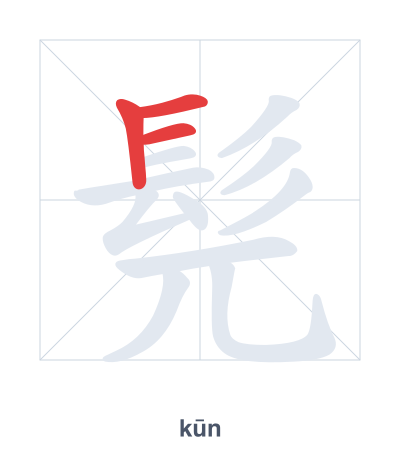
Open Hanzi Writer to see the animated stroke order and practice writing 髡 with real-time feedback.
The character 髡 (kūn) is written with 13 strokes. Follow the standard Chinese stroke order: top to bottom, left to right, outside before inside. The radical 髟 is one of its key components.
Practice the correct stroke order with the Hanzi Writer app to see animated stroke-by-stroke guidance with real-time feedback.
髡 means to shave the head.
| Character | 髡 |
| Pinyin | kūn (kun) |
| Meaning | to shave the head |
| Strokes | 13 |
| Radical | 髟 |
| Difficulty | 4.2/5 |
The character 髡 combines the radical 髟 (hair) with 兀, an ancient pictograph of a person with a bald head or a high, bare mound. Together, they depict the act of removing hair, specifically as a form of punishment or monastic tonsure. This compound visually conveys 'to shave the head.'
💡 Memory Tip: Picture a bald monk (兀) with a single strand of hair left on his head (髟), and a razor slicing it off cleanly.
他选择了髡发。
tā xuǎn zé le kūn fā
He chose to have his head shaved.
髡刑是古代的刑罚。
kūn xíng shì gǔ dài de xíng fá
Shaving the head was a form of punishment in ancient times.
他髡首以示决心。
tā kūn shǒu yǐ shì jué xīn
He shaved his head to show his determination.
Open Hanzi Writer to see the animated stroke order and practice writing 髡 with real-time feedback.
✨ Animated stroke order · Handwriting recognition · HSK-graded practice · Free to use
The character 髡 combines the radical 髟 (hair, top) with the component 兀 (wù, bottom). 髟 indicates the meaning relates to hair, while 兀 suggests cutting or shaving, so together the character means 'to shave the head'.