枥 (lì) means "stable; manger" in Chinese. It has 8 strokes with the radical 木.
Rated 3.7/5 in difficulty (challenging).
Appears in 3+ common words including 马枥 (mǎ lì), 老枥 (lǎo lì), 枥马 (lì mǎ).
Due to its 8 strokes, Hanzi Writer's error detection shows 枥 requires focused practice — most learners need 10+ attempts for consistent accuracy.
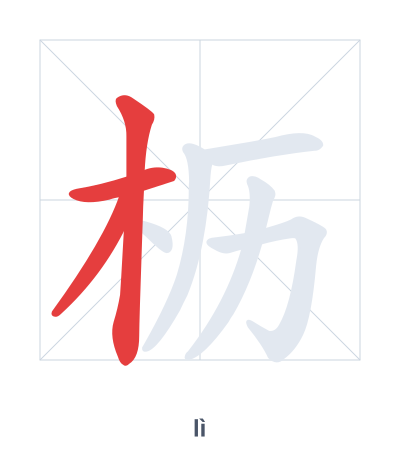
Open Hanzi Writer to see the animated stroke order and practice writing 枥 with real-time feedback.
The character 枥 (lì) is written with 8 strokes. Follow the standard Chinese stroke order: top to bottom, left to right, outside before inside. The radical 木 is one of its key components.
Practice the correct stroke order with the Hanzi Writer app to see animated stroke-by-stroke guidance with real-time feedback.
枥 means stable; manger.
枥 combines the radical 木 (wood) with 历 (lì, meaning 'to pass through' or 'calendar'), indicating a wooden structure where horses pass through to eat. The manger is a wooden trough in a stable, and the character originally referred to a wooden feeding box for horses.
💡 Memory Tip: Picture a wooden manager (木) that looks like a calendar (历) hung in a stable, where horses eat their hay.
马在马枥里休息。
mǎ zài mǎ lì lǐ xiū xī
The horse is resting in the stable.
老枥指年老的马。
lǎo lì zhǐ nián lǎo de mǎ
'Laoli' refers to an old horse.
枥马在马厩里。
lì mǎ zài mǎ jiù lǐ
The stable horse is in the stable.
Open Hanzi Writer to see the animated stroke order and practice writing 枥 with real-time feedback.
✨ Animated stroke order · Handwriting recognition · HSK-graded practice · Free to use
The character 枥 is made of the radical 木 (wood) on the left, which hints that a stable or manger was often built from wood. The right part is 历 (lì), which gives the pronunciation and does not directly carry meaning. Together, 木 tells you the material, and 历 tells you how to say the word.