咭 (jī) means "card (transliteration); giggling sound" in Chinese. It has 9 strokes with the radical 口.
Rated 4/5 in difficulty (challenging).
Appears in 3+ common words including 咭片 (jī piàn), 咭咭 (jī jī), 咭片盒 (jī piàn hé).
Due to its 9 strokes, Hanzi Writer's error detection shows 咭 requires focused practice — most learners need 10+ attempts for consistent accuracy.
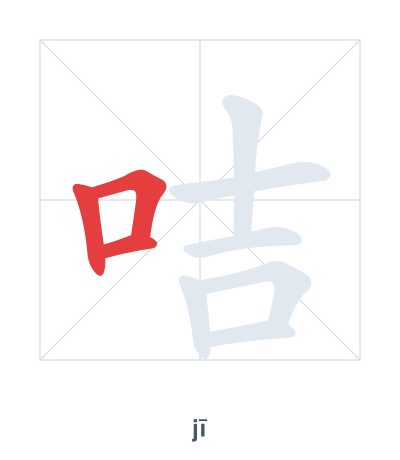
Open Hanzi Writer to see the animated stroke order and practice writing 咭 with real-time feedback.
The character 咭 (jī) is written with 9 strokes. Follow the standard Chinese stroke order: top to bottom, left to right, outside before inside. The radical 口 is one of its key components.
Practice the correct stroke order with the Hanzi Writer app to see animated stroke-by-stroke guidance with real-time feedback.
咭 means card (transliteration); giggling sound.
咭 is a phono-semantic compound formed by the radical 口 (mouth) indicating sounds or speech, and the phonetic component 吉 (jí,'auspicious') which provides the pronunciation. It is used as a transliteration for the English word 'card' and also depicts a light, giggling sound made by the mouth.
💡 Memory Tip: Imagine a mouth (口) saying 'gee' (吉) while holding a playing card, producing a giggling sound like 'hee-hee'.
这是我的咭片。
zhè shì wǒ de jī piàn
This is my business card.
小鸟咭咭地叫。
xiǎo niǎo jī jī dì jiào
The little bird is chirping.
咭片盒在桌上。
jī piàn hé zài zhuō shàng
The card case is on the table.
Open Hanzi Writer to see the animated stroke order and practice writing 咭 with real-time feedback.
✨ Animated stroke order · Handwriting recognition · HSK-graded practice · Free to use
咭 is composed of the radical 口 (mouth) on the left and 吉 (jí, meaning lucky) on the right. The mouth radical indicates that the character relates to sound or speech, which connects to its meaning of a giggling sound. The right part 吉 provides the pronunciation jī and also hints at the cheerful nature of giggling.