蟥 (huáng) means "Leech" in Chinese. It has 17 strokes with the radical 虫.
Rated 4.2/5 in difficulty (advanced).
Appears in 3+ common words including 蚂蟥 (mǎ huáng), 蟥虫 (huáng chóng), 蟥仔 (huáng zǎi).
Due to its 17 strokes, Hanzi Writer's error detection shows 蟥 requires focused practice — most learners need 10+ attempts for consistent accuracy.
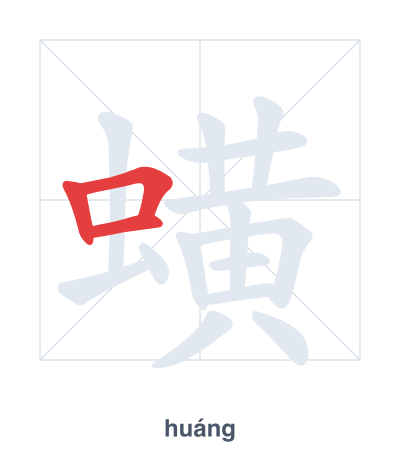
Open Hanzi Writer to see the animated stroke order and practice writing 蟥 with real-time feedback.
The character 蟥 (huáng) is written with 17 strokes. Follow the standard Chinese stroke order: top to bottom, left to right, outside before inside. The radical 虫 is one of its key components.
Practice the correct stroke order with the Hanzi Writer app to see animated stroke-by-stroke guidance with real-time feedback.
蟥 means Leech.
蟥 is a compound character with the radical 虫 (insect/worm) and the phonetic component 黄 (huáng, meaning 'yellow'). Leeches often have a yellowish-brown color, so the character suggests a yellow-colored worm. The phonetic 黄 also hints at the pronunciation huáng.
💡 Memory Tip: Picture a yellow (黄) worm (虫) that latches onto you—that's a leech (蟥).
水里有很多蚂蟥。
shuǐ lǐ yǒu hěn duō mǎ huáng
There are many leeches in the water.
蟥虫在草丛里。
huáng chóng zài cǎo cóng lǐ
The leech is in the grass.
这里的蟥仔很小。
zhè lǐ de huáng zǎi hěn xiǎo
The leeches here are very small.
Open Hanzi Writer to see the animated stroke order and practice writing 蟥 with real-time feedback.
✨ Animated stroke order · Handwriting recognition · HSK-graded practice · Free to use
The character 蟥 is composed of the radical 虫 (chóng), meaning 'insect' or 'creature,' on the left, and the phonetic component 黄 (huáng) on the right. Since a leech is a type of worm-like creature, the 虫 radical signals its animal category, while 黄 provides the pronunciation huáng. This is a typical phono-semantic compound where one part hints at meaning and the other at sound.