蚂 (mǎ/mà) means "Ant / Grasshopper (prefix)" in Chinese. It has 9 strokes with the radical 虫.
Rated 4/5 in difficulty (challenging).
Appears in 3+ common words including 蚂蚁 (mǎ yǐ), 蚂蚱 (mà zhà), 蚂蟥 (mǎ huáng).
Due to its 9 strokes, Hanzi Writer's error detection shows 蚂 requires focused practice — most learners need 10+ attempts for consistent accuracy.
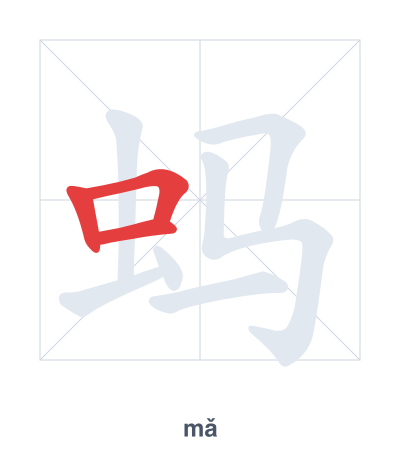
Open Hanzi Writer to see the animated stroke order and practice writing 蚂 with real-time feedback.
The character 蚂 (mǎ/mà) is written with 9 strokes. Follow the standard Chinese stroke order: top to bottom, left to right, outside before inside. The radical 虫 is one of its key components.
Practice the correct stroke order with the Hanzi Writer app to see animated stroke-by-stroke guidance with real-time feedback.
蚂 means Ant / Grasshopper (prefix).
This is a polyphonic character with readings: mǎ, mà.
This character is a phono-semantic compound. The radical 虫 (insect) indicates the meaning relates to bugs, while the component 马 (mǎ, horse) provides the pronunciation. Together, 蚂 is used as a prefix in words for insects like 蚂蚁 (ant) and 蚂蚱 (grasshopper).
💡 Memory Tip: Picture a tiny ant riding a galloping horse, shouting 'Giddy-up, mǎ!' as it steers with the reins.
蚂蚁很勤劳。
mǎ yǐ hěn qín láo
Ants are very industrious.
孩子在抓蚂蚱。
hái zi zài zhuā mà zhà
The child is catching grasshoppers.
蚂蟥在水里。
mǎ huáng zài shuǐ lǐ
The leech is in the water.
Open Hanzi Writer to see the animated stroke order and practice writing 蚂 with real-time feedback.
✨ Animated stroke order · Handwriting recognition · HSK-graded practice · Free to use
蚂 is made of two parts: the left side is 虫, meaning insect, and the right side is 马 (mǎ, horse), which gives the pronunciation. The insect radical tells you that 蚂 is used for names of small insects like ants and grasshoppers.