槐 (huái) means "Locust tree" in Chinese. It has 13 strokes with the radical 木, and is HSK Level 7.
Rated 4.2/5 in difficulty (advanced).
Harder than 64% of HSK Level 7 characters.
Appears in 3+ common words including 槐树 (huái shù), 槐花 (huái huā), 槐米 (huái mǐ).
Due to its 13 strokes, Hanzi Writer's error detection shows 槐 requires focused practice — most learners need 10+ attempts for consistent accuracy.
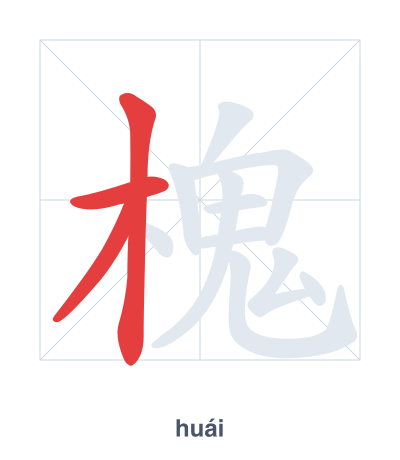
Open Hanzi Writer to see the animated stroke order and practice writing 槐 with real-time feedback.
The character 槐 (huái) is written with 13 strokes. Follow the standard Chinese stroke order: top to bottom, left to right, outside before inside. The radical 木 is one of its key components.
Practice the correct stroke order with the Hanzi Writer app to see animated stroke-by-stroke guidance with real-time feedback.
槐 means Locust tree.
As an HSK Level 7 character, 槐 is an intermediate-level character.
槐 combines the tree radical 木 with 鬼 (ghost/spirit), reflecting the ancient belief that locust trees were often planted near graves or temples and associated with spirits. The character visually represents a 'tree of ghosts' due to this cultural connection.
💡 Memory Tip: Imagine a ghost (鬼) peeking out from behind a tall locust tree (木), surprising you with a spooky 'huái!'
路边有一棵大槐树。
lù biān yǒu yī kē dà huái shù
There is a large locust tree by the roadside.
槐花开了,味道很香。
huái huā kāi le wèi dào hěn xiāng
The locust flowers are in bloom and smell very fragrant.
这种槐米可以用来泡茶。
zhè zhǒng huái mǐ kě yǐ yòng lái pào chá
These pagoda tree buds can be used to make tea.
Open Hanzi Writer to see the animated stroke order and practice writing 槐 with real-time feedback.
✨ Animated stroke order · Handwriting recognition · HSK-graded practice · Free to use
The character 槐 has the radical 木 (tree) on the left, showing it is a type of tree. The right part is 鬼 (ghost), which gives a hint to the pronunciation "huái". Together they form the character for the locust tree.