葫 (hú) means "gourd" in Chinese. It has 12 strokes with the radical 艹.
Rated 4.2/5 in difficulty (advanced).
Appears in 3+ common words including 葫芦 (hú lú), 糖葫芦 (táng hú lú), 西葫芦 (xī hú lú).
Due to its 12 strokes, Hanzi Writer's error detection shows 葫 requires focused practice — most learners need 10+ attempts for consistent accuracy.
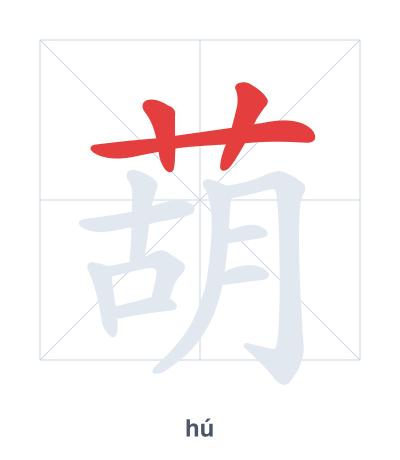
Open Hanzi Writer to see the animated stroke order and practice writing 葫 with real-time feedback.
The character 葫 (hú) is written with 12 strokes. Follow the standard Chinese stroke order: top to bottom, left to right, outside before inside. The radical 艹 is one of its key components.
Practice the correct stroke order with the Hanzi Writer app to see animated stroke-by-stroke guidance with real-time feedback.
葫 means gourd.
葫 is a phono-semantic compound: the top radical 艹 (grass/plant) indicates it is a type of plant, while the bottom component 胡 provides the pronunciation hú. Together they represent the gourd plant, whose fruit was used as a container in ancient China.
💡 Memory Tip: Picture a grassy plant (艹) with a large, round gourd hanging below, shaped like a bearded old man's head (胡).
这是一个葫芦。
zhè shì yí gè hú lú
This is a bottle gourd.
我爱吃糖葫芦。
wǒ ài chī táng hú lú
I love eating Tanghulu (candied haws).
西葫芦很好吃。
xī hú lú hěn hǎo chī
Zucchini is delicious.
Open Hanzi Writer to see the animated stroke order and practice writing 葫 with real-time feedback.
✨ Animated stroke order · Handwriting recognition · HSK-graded practice · Free to use
葫 combines the grass radical 艹 on top with 胡 underneath. The 艹 shows it is a plant, and 胡 gives the pronunciation hú. Together, they form the character for a gourd, which is a type of climbing plant.