嗥 (háo) means "To howl or roar." in Chinese. It has 13 strokes with the radical 口.
Rated 4.2/5 in difficulty (advanced).
Appears in 3+ common words including 狼嗥 (láng háo), 嗥叫 (háo jiào), 狂嗥 (kuáng háo).
Due to its 13 strokes, Hanzi Writer's error detection shows 嗥 requires focused practice — most learners need 10+ attempts for consistent accuracy.
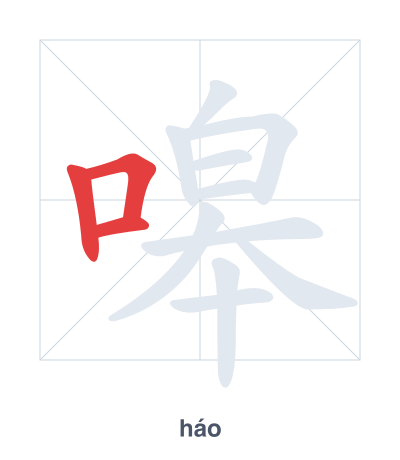
Open Hanzi Writer to see the animated stroke order and practice writing 嗥 with real-time feedback.
The character 嗥 (háo) is written with 13 strokes. Follow the standard Chinese stroke order: top to bottom, left to right, outside before inside. The radical 口 is one of its key components.
Practice the correct stroke order with the Hanzi Writer app to see animated stroke-by-stroke guidance with real-time feedback.
嗥 means To howl or roar..
嗥 is a phono-semantic compound: the mouth radical (口) indicates the sound, while 皋 (gāo) gives the pronunciation and originally depicted a high bank—evoking a beast howling from an elevated place.
💡 Memory Tip: Picture a wolf's mouth (口) open wide on a high cliff (皋) as it lets out a long, echoing 'Háo-o-o!'
远处传来狼嗥。
yuǎn chù chuán lái láng háo
The howling of a wolf came from the distance.
狼在对着月亮嗥叫。
láng zài duì zhe yuè liàng háo jiào
The wolf is howling at the moon.
狗在外面狂嗥。
gǒu zài wài miàn kuáng háo
The dog is howling wildly outside.
Open Hanzi Writer to see the animated stroke order and practice writing 嗥 with real-time feedback.
✨ Animated stroke order · Handwriting recognition · HSK-graded practice · Free to use
嗥 is composed of the radical 口 (mouth) on the left and the phonetic component 皋 (gāo, a high bank) on the right. The mouth radical suggests the sound comes from the mouth, while 皋 provides pronunciation and a vague image of a high place where a wolf might howl.