唅 (hán) means "To hold in the mouth." in Chinese. It has 10 strokes with the radical 口.
Rated 4.2/5 in difficulty (advanced).
Appears in 3+ common words including 唅着 (hán zhe), 唅一口 (hán yī kǒu), 唅笑 (hán xiào).
Due to its 10 strokes, Hanzi Writer's error detection shows 唅 requires focused practice — most learners need 10+ attempts for consistent accuracy.
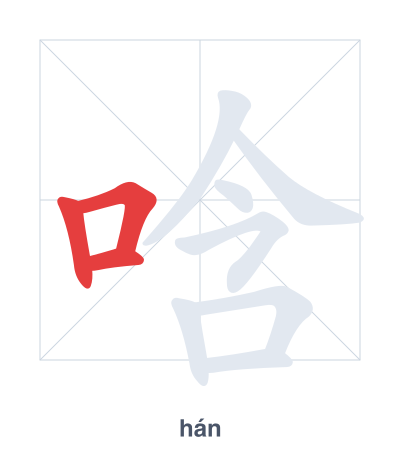
Open Hanzi Writer to see the animated stroke order and practice writing 唅 with real-time feedback.
The character 唅 (hán) is written with 10 strokes. Follow the standard Chinese stroke order: top to bottom, left to right, outside before inside. The radical 口 is one of its key components.
Practice the correct stroke order with the Hanzi Writer app to see animated stroke-by-stroke guidance with real-time feedback.
唅 means To hold in the mouth..
The character 唅 combines the mouth radical 口 with 含 (hán, itself a compound of 今 and 口 meaning 'to hold in the mouth'), reinforcing the idea of keeping something inside the mouth. The visual structure shows the mouth (口) acting together with the enclosed mouth in 含, emphasizing the action of holding without swallowing.
💡 Memory Tip: Picture two mouths—the left 口 and the bottom 口 inside 含—working together to trap a morsel, so it stays held in the mouth.
他嘴里唅着糖。
tā zuǐ lǐ hán zhe táng
He had a piece of candy in his mouth.
唅一口水漱漱口。
hán yī kǒu shuǐ shù shù kǒu
Take a mouthful of water to rinse your mouth.
她脸上带着唅笑。
tā liǎn shàng dài zhe hán xiào
She has a faint smile on her face.
Open Hanzi Writer to see the animated stroke order and practice writing 唅 with real-time feedback.
✨ Animated stroke order · Handwriting recognition · HSK-graded practice · Free to use
唅 is composed of the radical 口 (mouth) on the left and the phonetic component 含 (hán, meaning 'to contain') on the right. The mouth radical directly connects to the action of holding something in the mouth, while 含 provides the pronunciation and the idea of containing.