嗐 (hài) means "Alas; oh (interjection of regret or surprise)" in Chinese. It has 13 strokes with the radical 口.
Rated 4.2/5 in difficulty (advanced).
Appears in 1+ common words including 嗐 (hài).
Due to its 13 strokes, Hanzi Writer's error detection shows 嗐 requires focused practice — most learners need 10+ attempts for consistent accuracy.
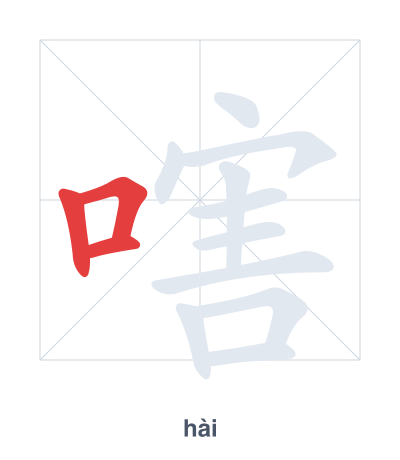
Open Hanzi Writer to see the animated stroke order and practice writing 嗐 with real-time feedback.
The character 嗐 (hài) is written with 13 strokes. Follow the standard Chinese stroke order: top to bottom, left to right, outside before inside. The radical 口 is one of its key components.
Practice the correct stroke order with the Hanzi Writer app to see animated stroke-by-stroke guidance with real-time feedback.
嗐 means Alas; oh (interjection of regret or surprise).
嗐 is a compound character combining the mouth radical 口 (depicting an open mouth) with 害 (hài, meaning 'harm' or 'damage'), which provides the pronunciation. Together, the character visually suggests a sound of regret or surprise escaping from the mouth in response to harm or misfortune.
💡 Memory Tip: Imagine someone opening their mouth wide (口) in dismay as they realize the harm (害) they've caused, letting out a loud 'Hài!' of regret.
嗐,别提那件事了。
hài bié tí nà jiàn shì le
Oh, don't mention that matter.
嗐,我把这事忘了。
hài wǒ bǎ zhè shì wàng le
Oh, I forgot about this.
嗐,真没办法。
hài zhēn méi bàn fǎ
Alas, there's really no way.
Open Hanzi Writer to see the animated stroke order and practice writing 嗐 with real-time feedback.
✨ Animated stroke order · Handwriting recognition · HSK-graded practice · Free to use
嗐 is made of two parts: the left side is the radical 口 (mouth), which shows it is a sound or interjection. The right side is 害 (hài), meaning harm or disaster, which gives the pronunciation and hints at the emotion of regret or dismay.