簋 (guǐ) means "ancient food vessel" in Chinese. It has 17 strokes with the radical 竹.
Rated 4.2/5 in difficulty (advanced).
Appears in 3+ common words including 簋街 (guǐ jiē), 青铜簋 (qīng tóng guǐ), 簋碗 (guǐ wǎn).
Due to its 17 strokes, Hanzi Writer's error detection shows 簋 requires focused practice — most learners need 10+ attempts for consistent accuracy.
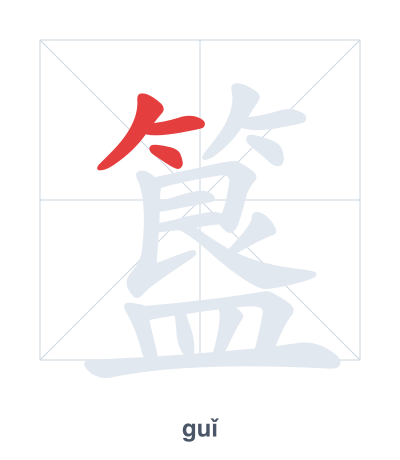
Open Hanzi Writer to see the animated stroke order and practice writing 簋 with real-time feedback.
The character 簋 (guǐ) is written with 17 strokes. Follow the standard Chinese stroke order: top to bottom, left to right, outside before inside. The radical 竹 is one of its key components.
Practice the correct stroke order with the Hanzi Writer app to see animated stroke-by-stroke guidance with real-time feedback.
簋 means ancient food vessel.
Originally a pictograph of a round food vessel with two handles and often a lid, used for offerings. The radical 竹 (bamboo) was added later to indicate the material, though actual vessels were often bronze or pottery.
💡 Memory Tip: Imagine a bamboo (竹) basket shaped like a bowl with two ear-like handles, packed with fragrant rice (皀) — that's the ancient food vessel 簋.
我们晚上去簋街吃饭吧。
wǒ men wǎn shàng qù guǐ jiē chī fàn ba
Let's go eat at Guijie tonight.
博物馆里有一个青铜簋。
bó wù guǎn lǐ yǒu yí gè qīng tóng guǐ
There is a bronze food container in the museum.
这个簋碗的形状很特别。
zhè ge guǐ wǎn de xíng zhuàng hěn tè bié
The shape of this ritual bronze bowl is very unique.
Open Hanzi Writer to see the animated stroke order and practice writing 簋 with real-time feedback.
✨ Animated stroke order · Handwriting recognition · HSK-graded practice · Free to use
The top part is the radical 竹 (bamboo), indicating the vessel was originally made of bamboo. The bottom part 皀 (not a common character today) suggests a container shape with food inside. Together, they represent an ancient food vessel.