悍 (hàn) means "fierce" in Chinese. It has 10 strokes with the radical 忄.
Rated 4.2/5 in difficulty (advanced).
Appears in 3+ common words including 强悍 (qiáng hàn), 凶悍 (xiōng hàn), 精悍 (jīng hàn).
Due to its 10 strokes, Hanzi Writer's error detection shows 悍 requires focused practice — most learners need 10+ attempts for consistent accuracy.
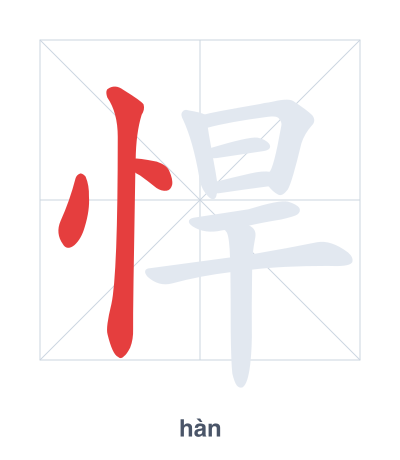
Open Hanzi Writer to see the animated stroke order and practice writing 悍 with real-time feedback.
The character 悍 (hàn) is written with 10 strokes. Follow the standard Chinese stroke order: top to bottom, left to right, outside before inside. The radical 忄 is one of its key components.
Practice the correct stroke order with the Hanzi Writer app to see animated stroke-by-stroke guidance with real-time feedback.
悍 means fierce.
悍 combines the heart radical (忄) with 旱 (drought), suggesting a fierce, harsh temperament like a scorching, waterless land. The heart radical links it to emotion, while 旱 contributes the sense of severity and dryness.
💡 Memory Tip: Picture a heart (忄) so fiercely angry that it dries up everything around it, causing a drought (旱).
他的身体很强悍。
tā de shēn tǐ hěn qiáng hàn
His body is very tough and powerful.
那个动物很凶悍。
nà ge dòng wù hěn xiōng hàn
That animal is very fierce.
这支队伍短小精悍。
zhè zhī duì wǔ duǎn xiǎo jīng hàn
This team is small but highly capable.
Open Hanzi Writer to see the animated stroke order and practice writing 悍 with real-time feedback.
✨ Animated stroke order · Handwriting recognition · HSK-graded practice · Free to use
The character 悍 combines the radical 忄 (heart/mind) on the left with 旱 (hàn, drought) on the right. The heart radical suggests an emotional or mental quality, while 旱 implies harshness or dryness, together conveying a fierce, tough nature. This structure reflects that fierceness is seen as a state of mind or temperament.