咣 (guāng) means "bang; clang (onomatopoeia)" in Chinese. It has 9 strokes with the radical 口.
Rated 4/5 in difficulty (challenging).
Appears in 3+ common words including 咣当 (guāng dāng), 咣的一声 (guāng de yī shēng), 咣咣 (guāng guāng).
Due to its 9 strokes, Hanzi Writer's error detection shows 咣 requires focused practice — most learners need 10+ attempts for consistent accuracy.
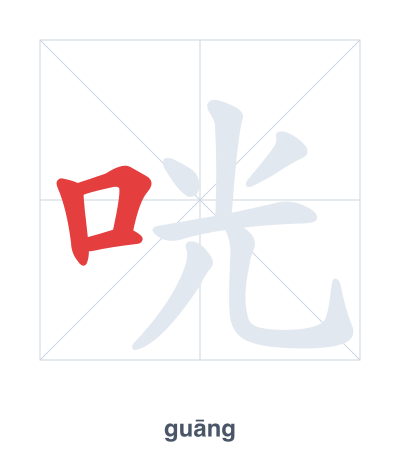
Open Hanzi Writer to see the animated stroke order and practice writing 咣 with real-time feedback.
The character 咣 (guāng) is written with 9 strokes. Follow the standard Chinese stroke order: top to bottom, left to right, outside before inside. The radical 口 is one of its key components.
Practice the correct stroke order with the Hanzi Writer app to see animated stroke-by-stroke guidance with real-time feedback.
咣 means bang; clang (onomatopoeia).
咣 combines the mouth radical (口) for sound with the phonetic component 光 (guāng, light). The character is an onomatopoeia representing a loud, abrupt noise like a bang or clang, as if the sound is as striking and sudden as a flash of light.
💡 Memory Tip: Imagine a lightbulb (光) suddenly exploding with a loud 'BANG!' and your mouth (口) forming the sound '咣'.
门咣当一声关了。
mén guāng dāng yī shēng guān le
The door closed with a bang.
咣的一声,碗碎了。
guāng de yī shēng wǎn suì le
With a crash, the bowl broke.
谁在咣咣敲门?
shuí zài guāng guāng qiāo mén
Who is banging on the door?
Open Hanzi Writer to see the animated stroke order and practice writing 咣 with real-time feedback.
✨ Animated stroke order · Handwriting recognition · HSK-graded practice · Free to use
咣 is made of two parts: the left radical 口 (mouth) and the right component 光 (light). The mouth radical tells you this character represents a sound, while 光 gives the pronunciation guāng. Together, they form an onomatopoeia for a loud bang or clang.