鹄 (gǔ) means "Swan" in Chinese. It has 12 strokes with the radical 鸟.
Rated 4.2/5 in difficulty (advanced).
Appears in 3+ common words including 鸿鹄 (hóng gǔ), 鹄立 (gǔ lì), 鹄望 (gǔ wàng).
Due to its 12 strokes, Hanzi Writer's error detection shows 鹄 requires focused practice — most learners need 10+ attempts for consistent accuracy.
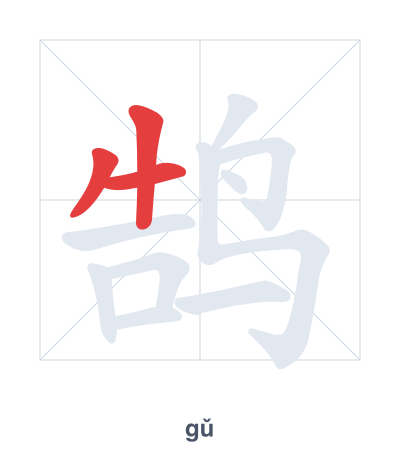
Open Hanzi Writer to see the animated stroke order and practice writing 鹄 with real-time feedback.
The character 鹄 (gǔ) is written with 12 strokes. Follow the standard Chinese stroke order: top to bottom, left to right, outside before inside. The radical 鸟 is one of its key components.
Practice the correct stroke order with the Hanzi Writer app to see animated stroke-by-stroke guidance with real-time feedback.
鹄 means Swan.
鹄 is a phono-semantic compound: the left component 告 (gào) provides the phonetic element, while the right component 鸟 (niǎo, 'bird') indicates the meaning. Together they denote a large water bird, specifically a swan.
💡 Memory Tip: Picture a swan (鸟) proudly stretching its neck to announce (告) its arrival with a loud 'Gǔ!' call.
鸿鹄志向远大。
hóng gǔ zhì xiàng yuǎn dà
A person of great ambition has lofty goals.
他在门口鹄立。
tā zài mén kǒu gǔ lì
He is standing and waiting expectantly at the door.
众人鹄望已久。
zhòng rén gǔ wàng yǐ jiǔ
Everyone has been looking forward to it for a long time.
Open Hanzi Writer to see the animated stroke order and practice writing 鹄 with real-time feedback.
✨ Animated stroke order · Handwriting recognition · HSK-graded practice · Free to use
鹄 is a left-right structure. The left component is 告 (gào, to tell), and the right component is 鸟 (niǎo, bird). Together, they form a bird that makes a specific call, referring to the swan.