酤 (gū) means "to buy or sell liquor" in Chinese. It has 12 strokes with the radical 酉.
Rated 4.2/5 in difficulty (advanced).
Appears in 3+ common words including 酤酒 (gū jiǔ), 屠酤 (tú gū), 酤卖 (gū mài).
Due to its 12 strokes, Hanzi Writer's error detection shows 酤 requires focused practice — most learners need 10+ attempts for consistent accuracy.
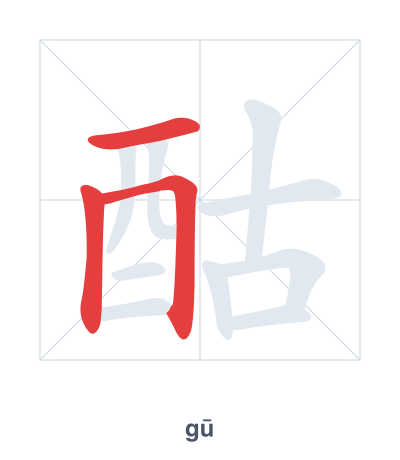
Open Hanzi Writer to see the animated stroke order and practice writing 酤 with real-time feedback.
The character 酤 (gū) is written with 12 strokes. Follow the standard Chinese stroke order: top to bottom, left to right, outside before inside. The radical 酉 is one of its key components.
Practice the correct stroke order with the Hanzi Writer app to see animated stroke-by-stroke guidance with real-time feedback.
酤 means to buy or sell liquor.
This character is a phono-semantic compound. The radical 酉 (a wine jar) signals that the meaning relates to liquor, while 古 (gǔ, meaning 'ancient' or 'old') provides the pronunciation. Together, they depict the act of buying or selling old, aged wine.
💡 Memory Tip: Picture an ancient (古) wine jar (酉) being traded at a market stall—this is where you buy or sell liquor (酤).
他去市集酤酒。
tā qù shì jí gū jiǔ
He went to the market to buy wine.
屠酤是古老的职业。
tú gū shì gǔ lǎo de zhí yè
Butchering and wine selling are ancient professions.
禁止私自酤卖。
jìn zhǐ sī zì gū mài
Private brewing and selling are prohibited.
Open Hanzi Writer to see the animated stroke order and practice writing 酤 with real-time feedback.
✨ Animated stroke order · Handwriting recognition · HSK-graded practice · Free to use
The left side is the radical 酉, which means "wine jar" and is associated with alcohol. The right side is 古 (gǔ, "ancient"), which provides the sound. Together, the character means to buy or sell liquor, linking the alcohol radical with the action of trade.