哿 (gě) means "Good, excellent, or commendable." in Chinese. It has 10 strokes with the radical 口.
Rated 3.9/5 in difficulty (challenging).
Appears in 3+ common words including 哿矣 (gě yǐ), 哿矣能言 (gě yǐ néng yán), 哿矣富人 (gě yǐ fù rén).
Due to its 10 strokes, Hanzi Writer's error detection shows 哿 requires focused practice — most learners need 10+ attempts for consistent accuracy.
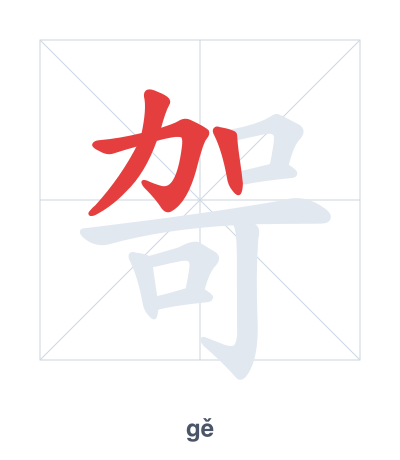
Open Hanzi Writer to see the animated stroke order and practice writing 哿 with real-time feedback.
The character 哿 (gě) is written with 10 strokes. Follow the standard Chinese stroke order: top to bottom, left to right, outside before inside. The radical 口 is one of its key components.
Practice the correct stroke order with the Hanzi Writer app to see animated stroke-by-stroke guidance with real-time feedback.
哿 means Good, excellent, or commendable..
哿 combines 加 (to add) and 口 (mouth), suggesting adding words of praise or commendation, hence meaning good or excellent.
💡 Memory Tip: Imagine a mouth (口) that can add (加) more mouths to shout 'excellent!' from every angle.
哿矣,可以也。
gě yǐ kě yǐ yě
It is good; it is acceptable.
这个人哿矣能言。
zhè ge rén gě yǐ néng yán
This person is eloquent and good at speaking.
哿矣富人,哀此惸独。
gě yǐ fù rén āi cǐ qióng dú
The rich are well off, but pity the lonely and poor.
Open Hanzi Writer to see the animated stroke order and practice writing 哿 with real-time feedback.
✨ Animated stroke order · Handwriting recognition · HSK-graded practice · Free to use
哿 is a top-bottom structure: the top part is 加 (jiā, meaning 'add') and the bottom part is 可 (kě, meaning 'acceptable' or 'able'). Together, they suggest something that is 'added' to being 'acceptable,' hence 'good' or 'commendable.' The radical 口 at the bottom is part of 可, not a separate meaning element.