矣 (yǐ) means "(particle used at the end of a sentence to indicate completion or change)" in Chinese. It has 7 strokes with the radical 矢, and is HSK Level 7.
Rated 3.5/5 in difficulty (challenging).
Harder than 20% of HSK Level 7 characters.
Appears in 3+ common words including 悔之晚矣 (huǐ zhī wǎn yǐ), 矣哉 (yǐ zāi), 鲜矣 (xiān yǐ).
Due to its 7 strokes, Hanzi Writer's error detection shows 矣 requires focused practice — most learners need 10+ attempts for consistent accuracy.
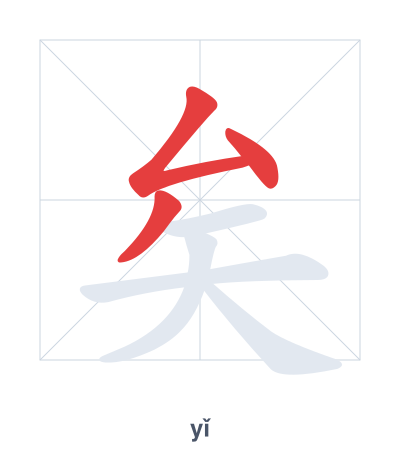
Open Hanzi Writer to see the animated stroke order and practice writing 矣 with real-time feedback.
The character 矣 (yǐ) is written with 7 strokes. Follow the standard Chinese stroke order: top to bottom, left to right, outside before inside. The radical 矢 is one of its key components.
Practice the correct stroke order with the Hanzi Writer app to see animated stroke-by-stroke guidance with real-time feedback.
矣 means (particle used at the end of a sentence to indicate completion or change).
As an HSK Level 7 character, 矣 is an intermediate-level character.
Originally a compound of 矢 (arrow) and 口 (mouth), ancient forms depicted an arrow hitting a target, suggesting completion or a change of state. The mouth may represent the exclamation made when something finishes. Over time, it evolved into a grammatical particle used at the end of sentences to indicate a completed action or a new situation.
💡 Memory Tip: Picture a person (厶) shooting an arrow (矢) and exclaiming 'Yǐ!' as it hits the bullseye, marking the completion.
错过机会,悔之晚矣。
cuò guò jī huì huǐ zhī wǎn yǐ
Once the opportunity is missed, it's too late for regrets.
悲矣哉!
bēi yǐ zāi
How sad it is!
这种好人鲜矣。
zhè zhǒng hǎo rén xiān yǐ
Good people like this are rare indeed.
Open Hanzi Writer to see the animated stroke order and practice writing 矣 with real-time feedback.
✨ Animated stroke order · Handwriting recognition · HSK-graded practice · Free to use
矣 is composed of 矢 (arrow) on top and 口 (mouth) on bottom. The arrow suggests an action reaching its target, and the mouth represents speech — together they form a particle that marks completion or a change of state at the end of a sentence.