膈 (gé) means "diaphragm" in Chinese. It has 14 strokes with the radical 月.
Rated 4.2/5 in difficulty (advanced).
Appears in 3+ common words including 膈肌 (gé jī), 横膈膜 (héng gé mó), 膈膜 (gé mó).
Due to its 14 strokes, Hanzi Writer's error detection shows 膈 requires focused practice — most learners need 10+ attempts for consistent accuracy.
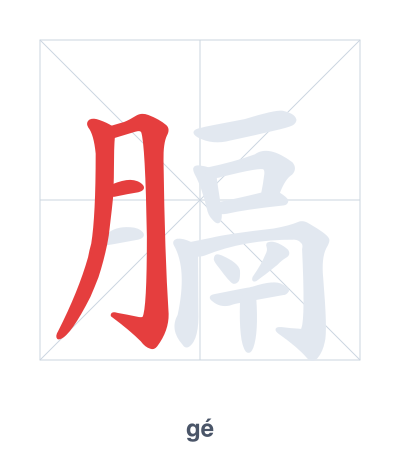
Open Hanzi Writer to see the animated stroke order and practice writing 膈 with real-time feedback.
The character 膈 (gé) is written with 14 strokes. Follow the standard Chinese stroke order: top to bottom, left to right, outside before inside. The radical 月 is one of its key components.
Practice the correct stroke order with the Hanzi Writer app to see animated stroke-by-stroke guidance with real-time feedback.
膈 means diaphragm.
膈 (gé) is a phono-semantic compound. The radical 月 (a form of 肉 'flesh') indicates it is a body part. The right component 鬲 (lì) originally depicted a tripod cooking vessel and here provides the sound hint, with the diaphragm being a muscular partition in the torso.
💡 Memory Tip: Picture the diaphragm as a fleshy tripod (鬲) inside your ribcage, separating your chest from your belly.
膈肌帮助呼吸。
gé jī bāng zhù hū xī
The diaphragm helps with breathing.
这是横膈膜。
zhè shì héng gé mó
This is the diaphragm.
膈膜在身体里。
gé mó zài shēn tǐ lǐ
The diaphragm is inside the body.
Open Hanzi Writer to see the animated stroke order and practice writing 膈 with real-time feedback.
✨ Animated stroke order · Handwriting recognition · HSK-graded practice · Free to use
The left part is 月, the radical for meat or flesh, showing this character relates to a body part. The right part is 鬲 (gé), an ancient cooking vessel, which hints at the diaphragm's shape as a dome-like lid separating the chest and abdomen.