嗝 (gé) means "Burp or hiccup." in Chinese. It has 13 strokes with the radical 口.
Rated 4.2/5 in difficulty (advanced).
Appears in 3+ common words including 打嗝 (dǎ gé), 饱嗝 (bǎo gé), 嗝 (gé).
Due to its 13 strokes, Hanzi Writer's error detection shows 嗝 requires focused practice — most learners need 10+ attempts for consistent accuracy.
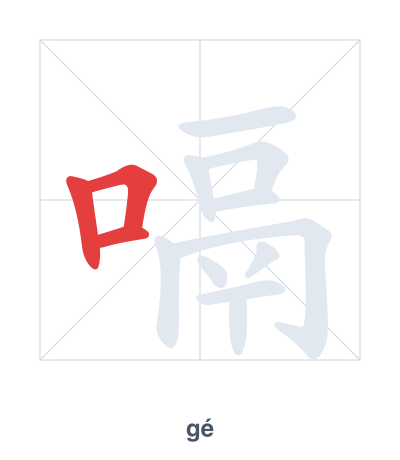
Open Hanzi Writer to see the animated stroke order and practice writing 嗝 with real-time feedback.
The character 嗝 (gé) is written with 13 strokes. Follow the standard Chinese stroke order: top to bottom, left to right, outside before inside. The radical 口 is one of its key components.
Practice the correct stroke order with the Hanzi Writer app to see animated stroke-by-stroke guidance with real-time feedback.
嗝 means Burp or hiccup..
嗝 is a phono-semantic compound. The radical 口 (mouth) indicates the sound or action of burping/hiccupping, while 鬲 (gé, an ancient tripod cauldron) provides the pronunciation and visually suggests the gurgling sound of a boiling pot, similar to a burp rising from the stomach.
💡 Memory Tip: Picture a mouth (口) letting out a loud burp because it just drank too much soup from a bubbling tripod pot (鬲).
我一直在打嗝。
wǒ yì zhí zài dǎ gé
I have been hiccuping.
他打了一个饱嗝。
tā dǎ le yí gè bǎo gé
He burped.
嗝,我吃饱了。
gé wǒ chī bǎo le
*Burp*, I'm full.
Open Hanzi Writer to see the animated stroke order and practice writing 嗝 with real-time feedback.
✨ Animated stroke order · Handwriting recognition · HSK-graded practice · Free to use
嗝 is composed of the mouth radical 口 on the left and the phonetic component 鬲 (gé) on the right. The mouth radical indicates the sound comes from the mouth, while 鬲 provides the pronunciation. Together, they form a character that represents the sound of a burp or hiccup.