噶 (gá) means "Gah (onomatopoeia for a sudden sound or stop)" in Chinese. It has 15 strokes with the radical 口.
Rated 4.2/5 in difficulty (advanced).
Appears in 3+ common words including 噶 (gá), 噶玛 (gá mǎ), 噶当 (gá dāng).
Due to its 15 strokes, Hanzi Writer's error detection shows 噶 requires focused practice — most learners need 10+ attempts for consistent accuracy.
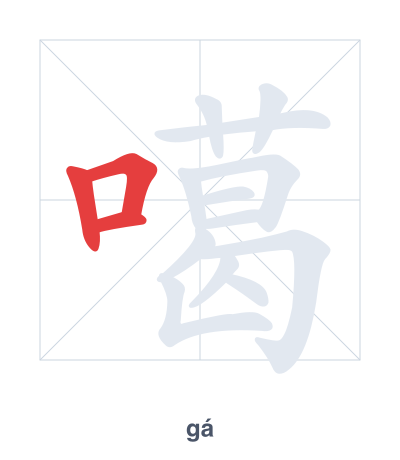
Open Hanzi Writer to see the animated stroke order and practice writing 噶 with real-time feedback.
The character 噶 (gá) is written with 15 strokes. Follow the standard Chinese stroke order: top to bottom, left to right, outside before inside. The radical 口 is one of its key components.
Practice the correct stroke order with the Hanzi Writer app to see animated stroke-by-stroke guidance with real-time feedback.
噶 means Gah (onomatopoeia for a sudden sound or stop).
噶 is a phono-semantic compound where the mouth radical (口) indicates the character relates to sounds or speech, while 葛 (gé) provides the phonetic component. Together, they form an onomatopoeia for a sudden, abrupt noise or stop, like a sharp exclamation.
💡 Memory Tip: Imagine your mouth (口) getting tangled in kudzu vines (葛) and you suddenly yell "Gah!" as you come to an abrupt stop.
噶,这是什么?
gá zhè shì shén me
Gah, what is this?
他叫噶玛。
tā jiào gá mǎ
His name is Karma.
这是一个噶当派寺庙。
zhè shì yí gè gá dāng pài sì miào
This is a Kadampa temple.
Open Hanzi Writer to see the animated stroke order and practice writing 噶 with real-time feedback.
✨ Animated stroke order · Handwriting recognition · HSK-graded practice · Free to use
噶 is made of the radical 口 (mouth) on the left and the phonetic component 葛 (gé) on the right. The 口 suggests the character represents a sound, while 葛 gives the approximate pronunciation "gá". Together, they form an onomatopoeia for a sudden sound or stop.