Hanzi Writer

How to Write 嘎 (gā) — Meaning “(Onomatopoeia) Quack / Creak”

14 strokes Radical: 口

嘎 (gā) means "(Onomatopoeia) Quack / Creak" in Chinese. It has 14 strokes with the radical 口.

Rated 4.2/5 in difficulty (advanced).

Appears in 3+ common words including 嘎嘎叫 (gā gā jiào), 嘎吱 (gā zhī), 嘎调 (gā diào).

Due to its 14 strokes, Hanzi Writer's error detection shows 嘎 requires focused practice — most learners need 10+ attempts for consistent accuracy.
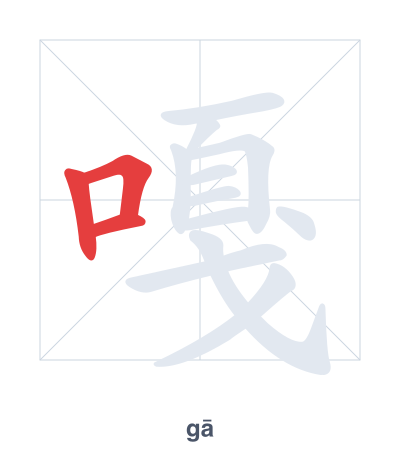
Stroke order practice for 嘎 - gā

Practice Writing 嘎 (gā)

Open Hanzi Writer to see the animated stroke order and practice writing 嘎 with real-time feedback.

The character (gā) is written with 14 strokes. Follow the standard Chinese stroke order: top to bottom, left to right, outside before inside. The radical is one of its key components.

Practice the correct stroke order with the Hanzi Writer app to see animated stroke-by-stroke guidance with real-time feedback.

means (Onomatopoeia) Quack / Creak.

Character
Pinyingā (ga)
Meaning(Onomatopoeia) Quack / Creak
Strokes14
Radical
Difficulty4.2/5

The character 嘎 combines the mouth radical (口) indicating a sound with 戛, a component that itself denotes a sharp, snapping noise. Together they form an onomatopoeic character for abrupt sounds like a duck's quack or a door's creak.

💡 Memory Tip: Imagine a duck's beak (口) quacking 'ga' as it pushes open a creaky gate (戛) that squeaks in protest.

gā gā jiào
To quack / To cackle
gā zhī
(Onomatopoeia) Creak / Squeak
gā diào
Naughty tone / Peculiar manner

鸭子嘎嘎叫。

yā zi gā gā jiào

The duck quacks.

门嘎吱一声开了。

mén gā zhī yī shēng kāi le

The door opened with a creak.

他的嗓音有嘎调。

tā de sǎng yīn yǒu gā diào

His voice has a crack in it.

Character Pinyin Strokes Radical
(current) 14
14
chì 12
12
Stroke order practice for 嘎 - gā

Practice Writing 嘎 (gā)

Open Hanzi Writer to see the animated stroke order and practice writing 嘎 with real-time feedback.

✨ Animated stroke order · Handwriting recognition · HSK-graded practice · Free to use

Frequently Asked Questions about 嘎

嘎 is composed of the radical 口 (mouth) on the left and 夏 (summer, pronounced xià) on the right. The 口 radical connects to sounds made by the mouth, matching its onomatopoeic uses like quacking or creaking. The right side 夏 provides the pronunciation hint (ga is not from xià, but the shape is used phonetically).

Characters with Radical 口

Other 14-Stroke Characters