吱 (zhī) means "to squeak; to make a sound" in Chinese. It has 7 strokes with the radical 口.
Rated 3.5/5 in difficulty (challenging).
Appears in 3+ common words including 吱声 (zhī shēng), 吱吱叫 (zhī zhī jiào), 吱一声 (zhī yī shēng).
Due to its 7 strokes, Hanzi Writer's error detection shows 吱 requires focused practice — most learners need 10+ attempts for consistent accuracy.
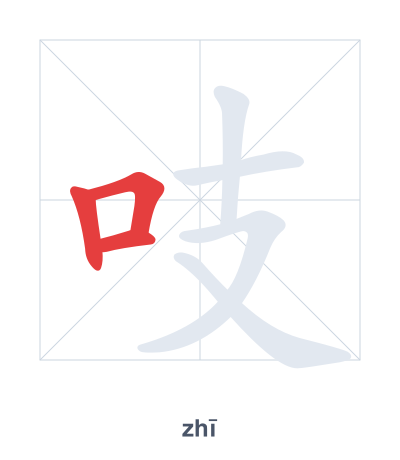
Open Hanzi Writer to see the animated stroke order and practice writing 吱 with real-time feedback.
The character 吱 (zhī) is written with 7 strokes. Follow the standard Chinese stroke order: top to bottom, left to right, outside before inside. The radical 口 is one of its key components.
Practice the correct stroke order with the Hanzi Writer app to see animated stroke-by-stroke guidance with real-time feedback.
吱 means to squeak; to make a sound.
吱 is a phono-semantic compound: the mouth radical (口) indicates the source of sound, while 支 (zhī, meaning branch) provides the pronunciation. The character originally depicted the squeaking or chirping sounds made by small animals or birds, often associated with perching on branches.
💡 Memory Tip: Picture a bird on a branch (支) opening its mouth (口) to let out a tiny squeak.
他半天没吱声。
tā bàn tiān méi zhī shēng
He didn't make a sound for a long time.
小老鼠吱吱叫。
xiǎo lǎo shǔ zhī zhī jiào
The little mouse is squeaking.
到了记得吱一声。
dào le jì de zhī yī shēng
Let me know when you arrive.
Open Hanzi Writer to see the animated stroke order and practice writing 吱 with real-time feedback.
✨ Animated stroke order · Handwriting recognition · HSK-graded practice · Free to use
吱 is made of the radical 口 (mouth) on the left and 支 (zhī, a phonetic component) on the right. The mouth radical suggests sound or speech, while 支 gives the pronunciation. Together, the character represents making a sound from the mouth, like a squeak or chirp.