呷 (gā) means "to sip / to swallow" in Chinese. It has 8 strokes with the radical 口.
Rated 3.7/5 in difficulty (challenging).
Appears in 3+ common words including 呷一口 (gā yī kǒu), 呷茶 (gā chá), 呷汤 (gā tāng).
Due to its 8 strokes, Hanzi Writer's error detection shows 呷 requires focused practice — most learners need 10+ attempts for consistent accuracy.
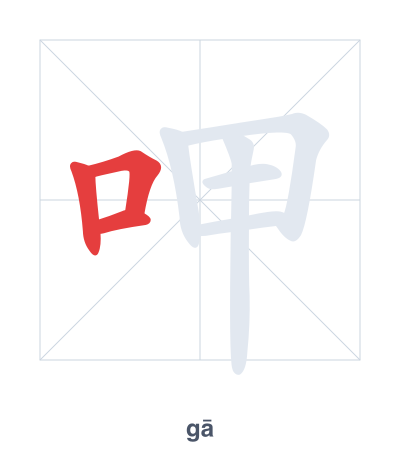
Open Hanzi Writer to see the animated stroke order and practice writing 呷 with real-time feedback.
The character 呷 (gā) is written with 8 strokes. Follow the standard Chinese stroke order: top to bottom, left to right, outside before inside. The radical 口 is one of its key components.
Practice the correct stroke order with the Hanzi Writer app to see animated stroke-by-stroke guidance with real-time feedback.
呷 means to sip / to swallow.
呷 is a phono-semantic compound where 口 (mouth) indicates the action of sipping or swallowing, and 甲 (jiǎ, armor) provides the pronunciation (gā). The character visually combines a mouth with a pictograph of armor, suggesting the idea of taking in liquid through the mouth like a guarded sip.
💡 Memory Tip: Imagine a mouth (口) sipping a hot drink through the slit of a suit of armor (甲), making a small 'gā' sound with each careful swallow.
他呷了一口热咖啡。
tā gā le yī kǒu rè kā fēi
He took a sip of hot coffee.
爷爷在阳台上呷茶。
yé yé zài yáng tái shàng gā chá
Grandpa is sipping tea on the balcony.
她轻轻地呷了一口汤。
tā qīng qīng dì gā le yī kǒu tāng
She took a small sip of the soup.
Open Hanzi Writer to see the animated stroke order and practice writing 呷 with real-time feedback.
✨ Animated stroke order · Handwriting recognition · HSK-graded practice · Free to use
呷 is made of two parts: the left part 口 (mouth radical) and the right part 甲 (jiǎ, meaning shell or armor). The mouth radical shows the action involves the mouth, while 甲 gives the pronunciation gā and suggests the idea of taking in something small, like a sip.