腑 (fǔ) means "Internal organs (hollow)" in Chinese. It has 12 strokes with the radical 月.
Rated 4.2/5 in difficulty (advanced).
Appears in 3+ common words including 肺腑 (fèi fǔ), 六腑 (liù fǔ), 腑脏 (fǔ zàng).
Due to its 12 strokes, Hanzi Writer's error detection shows 腑 requires focused practice — most learners need 10+ attempts for consistent accuracy.
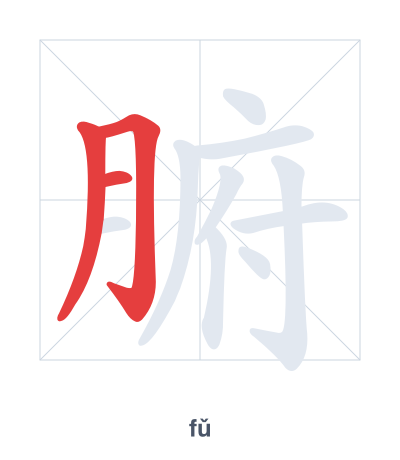
Open Hanzi Writer to see the animated stroke order and practice writing 腑 with real-time feedback.
The character 腑 (fǔ) is written with 12 strokes. Follow the standard Chinese stroke order: top to bottom, left to right, outside before inside. The radical 月 is one of its key components.
Practice the correct stroke order with the Hanzi Writer app to see animated stroke-by-stroke guidance with real-time feedback.
腑 means Internal organs (hollow).
The left radical 月 (meat/flesh) indicates the body, while the right component 府 (fǔ, meaning 'mansion' or 'government office') suggests that these organs act as storehouses or 'mansions' for vital substances. Together, 腑 refers to the hollow internal organs like the stomach, intestines, and bladder in traditional Chinese medicine.
💡 Memory Tip: Picture a fleshy mansion (月+府) where your hollow organs throw a party for all the food you eat.
这是我的肺腑之言。
zhè shì wǒ de fèi fǔ zhī yán
These are my heartfelt words.
五脏六腑都要健康。
wǔ zàng liù fǔ dōu yào jiàn kāng
All the internal organs should be healthy.
医生检查他的腑脏。
yī shēng jiǎn chá tā de fǔ zàng
The doctor examined his internal organs.
Open Hanzi Writer to see the animated stroke order and practice writing 腑 with real-time feedback.
✨ Animated stroke order · Handwriting recognition · HSK-graded practice · Free to use
腑 consists of the radical 月 (meat/flesh) on the left, indicating it relates to body parts, and the phonetic component 府 (fǔ) on the right. The combination suggests internal organs made of flesh, specifically the hollow organs in traditional Chinese medicine.