腓 (féi) means "Calf (of the leg)" in Chinese. It has 12 strokes with the radical 月.
Rated 4.2/5 in difficulty (advanced).
Appears in 3+ common words including 腓骨 (féi gǔ), 腓肠肌 (féi cháng jī), 腓侧 (féi cè).
Due to its 12 strokes, Hanzi Writer's error detection shows 腓 requires focused practice — most learners need 10+ attempts for consistent accuracy.
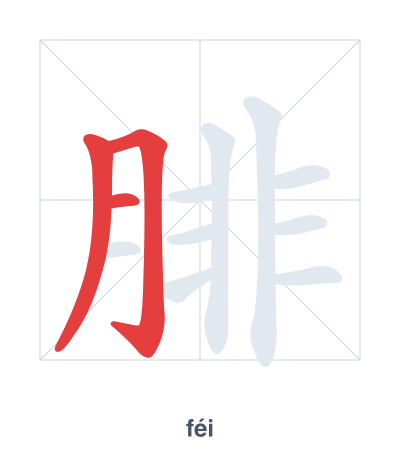
Open Hanzi Writer to see the animated stroke order and practice writing 腓 with real-time feedback.
The character 腓 (féi) is written with 12 strokes. Follow the standard Chinese stroke order: top to bottom, left to right, outside before inside. The radical 月 is one of its key components.
Practice the correct stroke order with the Hanzi Writer app to see animated stroke-by-stroke guidance with real-time feedback.
腓 means Calf (of the leg).
腓 combines the radical 月 (flesh/body part) with 非 (fēi), which originally depicted two opposing wings—echoing the paired calf muscles on each leg. The phonetic component suggests the sound, while the visual of opposing halves mirrors the calf's bilateral muscle structure.
💡 Memory Tip: Picture a leg with two crescent moons (非) as the calf muscles bulging under the skin (月).
他的腓骨受伤了。
tā de féi gǔ shòu shāng le
His fibula is injured.
腓肠肌在小腿上。
féi cháng jī zài xiǎo tuǐ shàng
The calf muscle is on the lower leg.
伤口在小腿腓侧。
shāng kǒu zài xiǎo tuǐ féi cè
The wound is on the outer side of the calf.
Open Hanzi Writer to see the animated stroke order and practice writing 腓 with real-time feedback.
✨ Animated stroke order · Handwriting recognition · HSK-graded practice · Free to use
The character 腓 combines the radical 月 (flesh/body) on the left and the phonetic component 非 on the right. The radical 月 indicates that the character relates to a body part, while 非 gives the pronunciation féi. Together they mean 'calf of the leg.'