鲱 (fēi) means "Herring" in Chinese. It has 16 strokes with the radical 鱼.
Rated 4.2/5 in difficulty (advanced).
Appears in 3+ common words including 鲱鱼 (fēi yú), 鲱鱼罐头 (fēi yú guàn tou), 太平洋鲱 (tài píng yáng fēi).
Due to its 16 strokes, Hanzi Writer's error detection shows 鲱 requires focused practice — most learners need 10+ attempts for consistent accuracy.
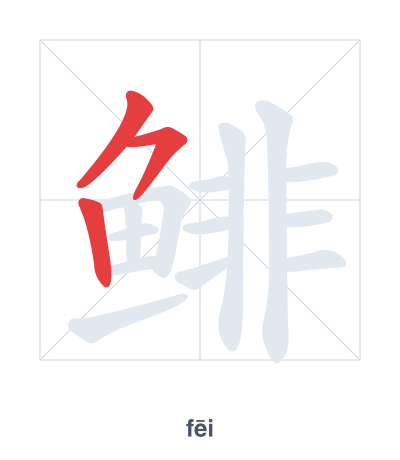
Open Hanzi Writer to see the animated stroke order and practice writing 鲱 with real-time feedback.
The character 鲱 (fēi) is written with 16 strokes. Follow the standard Chinese stroke order: top to bottom, left to right, outside before inside. The radical 鱼 is one of its key components.
Practice the correct stroke order with the Hanzi Writer app to see animated stroke-by-stroke guidance with real-time feedback.
鲱 means Herring.
The character 鲱 is a semantic-phonetic compound. The left radical 鱼 (fish) indicates the meaning, while the right component 非 (fēi) provides the pronunciation, serving as a phonetic hint for the sound 'fei'. It specifically refers to the herring, a type of fish.
💡 Memory Tip: Picture a fish (鱼) that repeatedly slaps away your fishing hook, shouting 'not today!' (非) — that stubborn fish is a herring.
鲱鱼生活在大海里。
fēi yú shēng huó zài dà hǎi lǐ
Herring live in the ocean.
鲱鱼罐头的味道很重。
fēi yú guàn tou de wèi dào hěn zhòng
Canned herring has a very strong smell.
太平洋鲱的数量很多。
tài píng yáng fēi de shù liàng hěn duō
There are many Pacific herrings.
Open Hanzi Writer to see the animated stroke order and practice writing 鲱 with real-time feedback.
✨ Animated stroke order · Handwriting recognition · HSK-graded practice · Free to use
The character 鲱 is made of the radical 鱼 (fish) on the left and the phonetic component 非 (fēi) on the right. The fish radical shows that the character belongs to the fish category, while 非 supplies the pronunciation and does not contribute to meaning.