贩 (fàn) means "To trade / To peddle / Dealer" in Chinese. It has 8 strokes with the radical 贝, and is HSK Level 7.
Rated 3.7/5 in difficulty (challenging).
Harder than 31% of HSK Level 7 characters.
Appears in 3+ common words including 小贩 (xiǎo fàn), 贩卖 (fàn mài), 菜贩 (cài fàn).
Due to its 8 strokes, Hanzi Writer's error detection shows 贩 requires focused practice — most learners need 10+ attempts for consistent accuracy.
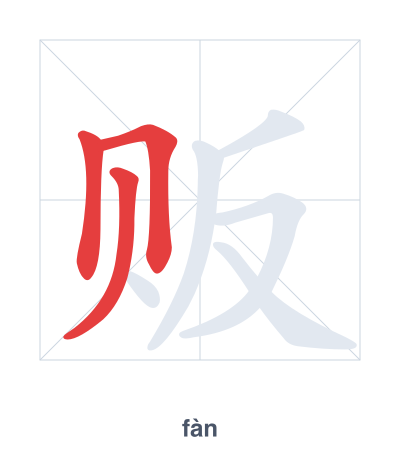
Open Hanzi Writer to see the animated stroke order and practice writing 贩 with real-time feedback.
The character 贩 (fàn) is written with 8 strokes. Follow the standard Chinese stroke order: top to bottom, left to right, outside before inside. The radical 贝 is one of its key components.
Practice the correct stroke order with the Hanzi Writer app to see animated stroke-by-stroke guidance with real-time feedback.
贩 means To trade / To peddle / Dealer.
As an HSK Level 7 character, 贩 is an intermediate-level character.
The character 贩 combines the radical 贝 (shell, representing money) with 反 (reverse, turn over), visually depicting the act of buying goods and then turning them around to sell for profit—a core merchant activity.
💡 Memory Tip: Picture a vendor using a shell (贝) as a coin while flipping it over (反) to show a customer, sealing a quick trade.
街边有很多小贩。
jiē biān yǒu hěn duō xiǎo fàn
There are many street vendors.
这里禁止贩卖烟酒。
zhè lǐ jìn zhǐ fàn mài yān jiǔ
Selling tobacco and alcohol is prohibited here.
我常去那个菜贩那。
wǒ cháng qù nà ge cài fàn nà
I often go to that vegetable vendor.
Open Hanzi Writer to see the animated stroke order and practice writing 贩 with real-time feedback.
✨ Animated stroke order · Handwriting recognition · HSK-graded practice · Free to use
贩 is made of two parts: the radical 贝 (shell/money) on the left and 反 (fǎn, opposite) on the right. The 贝 component connects the character to trade and wealth, while 反 provides the pronunciation. Together they create the meaning of 'to trade' or 'to peddle'.