阏 (è) means "to block; to stop" in Chinese. It has 11 strokes with the radical 门.
Rated 4.2/5 in difficulty (advanced).
Appears in 3+ common words including 阏氏 (è shì), 阏塞 (è sāi), 阏绝 (è jué).
Due to its 11 strokes, Hanzi Writer's error detection shows 阏 requires focused practice — most learners need 10+ attempts for consistent accuracy.
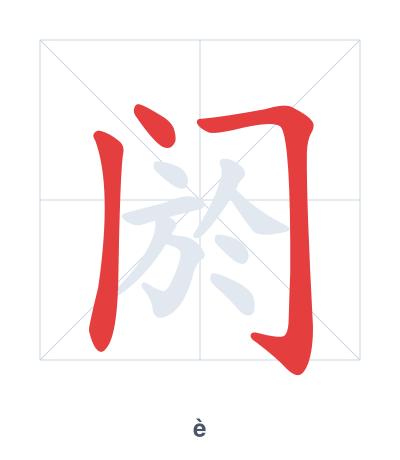
Open Hanzi Writer to see the animated stroke order and practice writing 阏 with real-time feedback.
The character 阏 (è) is written with 11 strokes. Follow the standard Chinese stroke order: top to bottom, left to right, outside before inside. The radical 门 is one of its key components.
Practice the correct stroke order with the Hanzi Writer app to see animated stroke-by-stroke guidance with real-time feedback.
阏 means to block; to stop.
阏 is a phono-semantic compound: the radical 门 (door) indicates a barrier or blockage, while 於 (yú) provides the phonetic component. Its ancient meaning of 'to block, to stop' derives from the idea of a door being obstructed or closed off. The visual form directly connects a gate (门) with an action of blocking through the phonetic element.
💡 Memory Tip: Picture a door (门) with a person (於, resembling two arms spread wide) standing in front, shouting 'Stop!' to block entry.
阏氏是古代匈奴的王后。
è shì shì gǔ dài xiōng nú de wáng hòu
Yanshi was the queen of the ancient Xiongnu.
道路被大雪阏塞了。
dào lù bèi dà xuě è sāi le
The road was blocked by heavy snow.
水源被彻底阏绝了。
shuǐ yuán bèi chè dǐ è jué le
The water source has been completely cut off.
Open Hanzi Writer to see the animated stroke order and practice writing 阏 with real-time feedback.
✨ Animated stroke order · Handwriting recognition · HSK-graded practice · Free to use
阏 consists of the radical 门 (door/gate) on the outside and the phonetic component 於 inside. The door radical suggests an action related to a gate, such as blocking or closing. This structure directly supports the character's meaning 'to block' or 'to stop.'