碘 (diǎn) means "Iodine" in Chinese. It has 13 strokes with the radical 石.
Rated 4.2/5 in difficulty (advanced).
Appears in 3+ common words including 碘酒 (diǎn jiǔ), 碘盐 (diǎn yán), 补碘 (bǔ diǎn).
Due to its 13 strokes, Hanzi Writer's error detection shows 碘 requires focused practice — most learners need 10+ attempts for consistent accuracy.
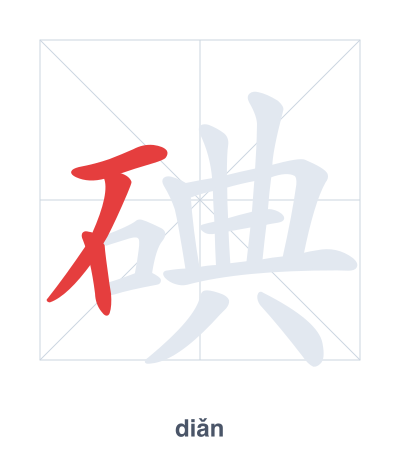
Open Hanzi Writer to see the animated stroke order and practice writing 碘 with real-time feedback.
The character 碘 (diǎn) is written with 13 strokes. Follow the standard Chinese stroke order: top to bottom, left to right, outside before inside. The radical 石 is one of its key components.
Practice the correct stroke order with the Hanzi Writer app to see animated stroke-by-stroke guidance with real-time feedback.
碘 means Iodine.
The character 碘 combines the radical 石 (stone/mineral) to indicate that iodine is a mineral-related substance, with 典 (diǎn) serving as a phonetic component to suggest the pronunciation. It was coined in modern Chinese to represent the chemical element iodine, which is often found in mineral deposits or seaweed.
💡 Memory Tip: Picture a stone (石) inscribed with ancient classics (典), but instead of ink, it's stained with purple iodine vapor.
伤口上要涂点碘酒。
shāng kǒu shàng yào tú diǎn diǎn jiǔ
Apply some iodine to the wound.
我们家一直吃碘盐。
wǒ men jiā yì zhí chī diǎn yán
Our family always uses iodized salt.
身体需要适量补碘。
shēn tǐ xū yào shì liàng bǔ diǎn
The body needs an appropriate amount of iodine supplement.
Open Hanzi Writer to see the animated stroke order and practice writing 碘 with real-time feedback.
✨ Animated stroke order · Handwriting recognition · HSK-graded practice · Free to use
The character 碘 is composed of the radical 石 (stone) on the left and the component 典 (diǎn) on the right. The radical indicates that iodine is a solid mineral element, while 典 provides the pronunciation clue (it sounds like diǎn). Together, they form a character for the chemical element iodine.