垤 (dié) means "anthill; small mound" in Chinese. It has 9 strokes with the radical 土.
Rated 4/5 in difficulty (challenging).
Appears in 3+ common words including 蚁垤 (yǐ dié), 丘垤 (qiū dié), 垤穴 (dié xué).
Due to its 9 strokes, Hanzi Writer's error detection shows 垤 requires focused practice — most learners need 10+ attempts for consistent accuracy.
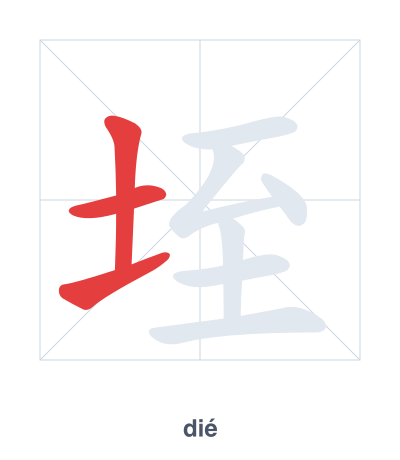
Open Hanzi Writer to see the animated stroke order and practice writing 垤 with real-time feedback.
The character 垤 (dié) is written with 9 strokes. Follow the standard Chinese stroke order: top to bottom, left to right, outside before inside. The radical 土 is one of its key components.
Practice the correct stroke order with the Hanzi Writer app to see animated stroke-by-stroke guidance with real-time feedback.
垤 means anthill; small mound.
The character combines the radical 土 (earth) with the phonetic component 至 (arrive), picturing earth that has been piled up—like an anthill or small mound where ants arrive. The ancient form showed a heap of dirt, reinforcing the idea of a raised mound.
💡 Memory Tip: Picture a tiny mound of earth (土) where ants are arriving (至) from all directions, making it an anthill.
地上有个小蚁垤。
dì shàng yǒu gè xiǎo yǐ dié
There is a small anthill on the ground.
远处有一些小丘垤。
yuǎn chù yǒu yī xiē xiǎo qiū dié
There are some small mounds in the distance.
蚂蚁住在垤穴里。
mǎ yǐ zhù zài dié xué lǐ
Ants live in anthills.
Open Hanzi Writer to see the animated stroke order and practice writing 垤 with real-time feedback.
✨ Animated stroke order · Handwriting recognition · HSK-graded practice · Free to use
The left side is the radical 土 (tǔ, meaning 'earth' or 'soil'), which shows that the character relates to ground. The right side is 至 (zhì, meaning 'arrive'), which originally contributed to the sound, though the modern pronunciation dié differs. Together they suggest a small mound of earth, like an anthill.